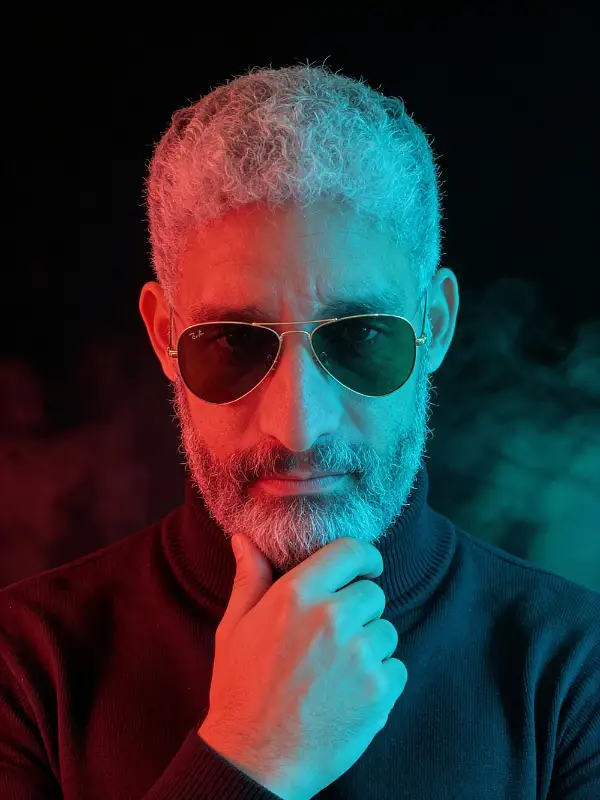
By Brushly · Artist Spotlight · June 2026
There is a particular kind of unhappiness that makes you look more carefully at the world. Tom Ang found it young. Removed, as he has described it, from a world he wasn't content in, he turned outward — to the small, intricate wonders that most people walk past without seeing. The closer he looked, the calmer he became. That instinct became a habit, the habit became a practice, and the practice became one of the most wide-ranging careers in the history of photography.
Today, Tom Ang is many things at once: an internationally awarded photographer, the author of Photography: The Definitive Visual History — a book now in millions of homes worldwide — and the presenter of three television series, two produced for the BBC and one for CNA Singapore. In 2019, he received the Hamdan International Photo Award as Content Producer, one of the field's most prestigious recognitions. For five decades, the camera was his primary instrument of thought. Then he set it down — or rather, folded it into something larger.
"After 50 years in photography, I'm back to art — but through a fusion of the two."
— Tom Ang
That fusion is the defining project of Ang's current work. His canvases — if they can be called that — are intricate, layered fields built from photography, calligraphy, ink, paint, and light. They reject the single focal point that photography typically demands. There is no hero, no subject in the traditional sense. Instead, every fragment of the composition carries its own weight, its own small articulation, inviting the eye to wander rather than land. Ang describes his role not as author but as co-creator — working alongside chance and nature to build something neither could produce alone.
The Journey
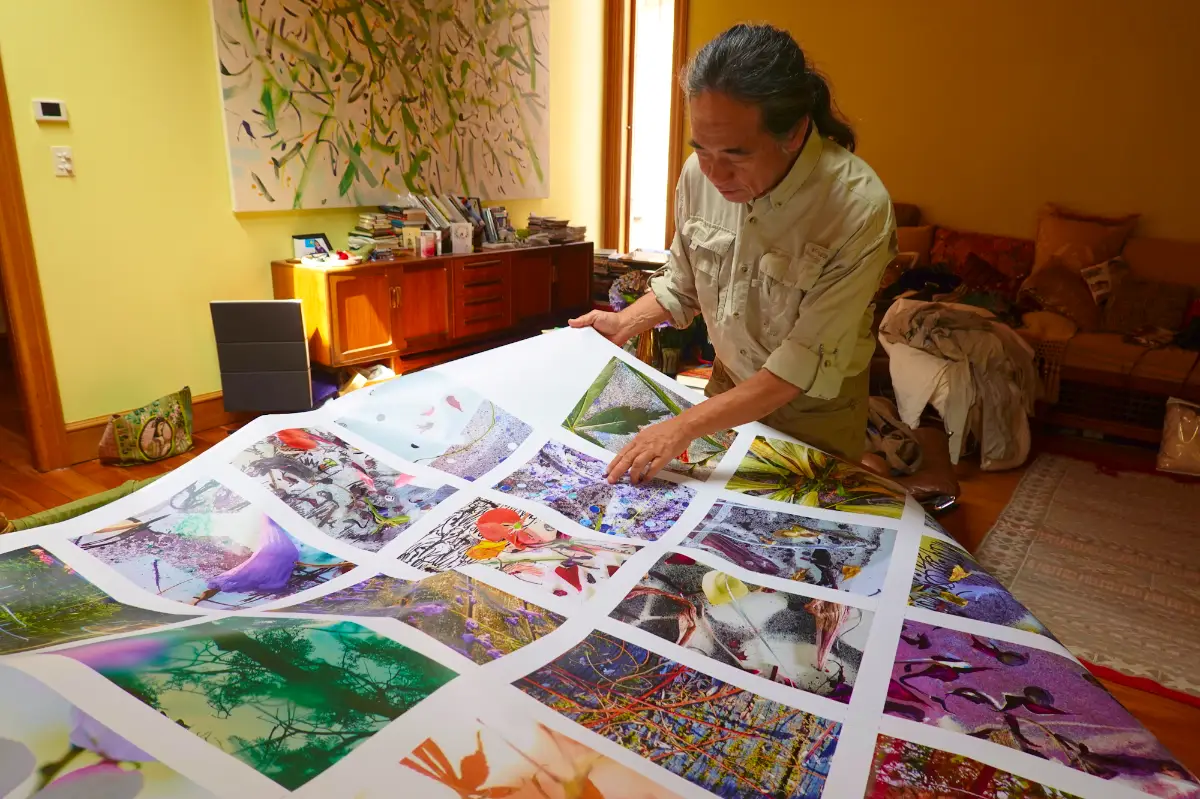
Tom Ang's Studio Workspace
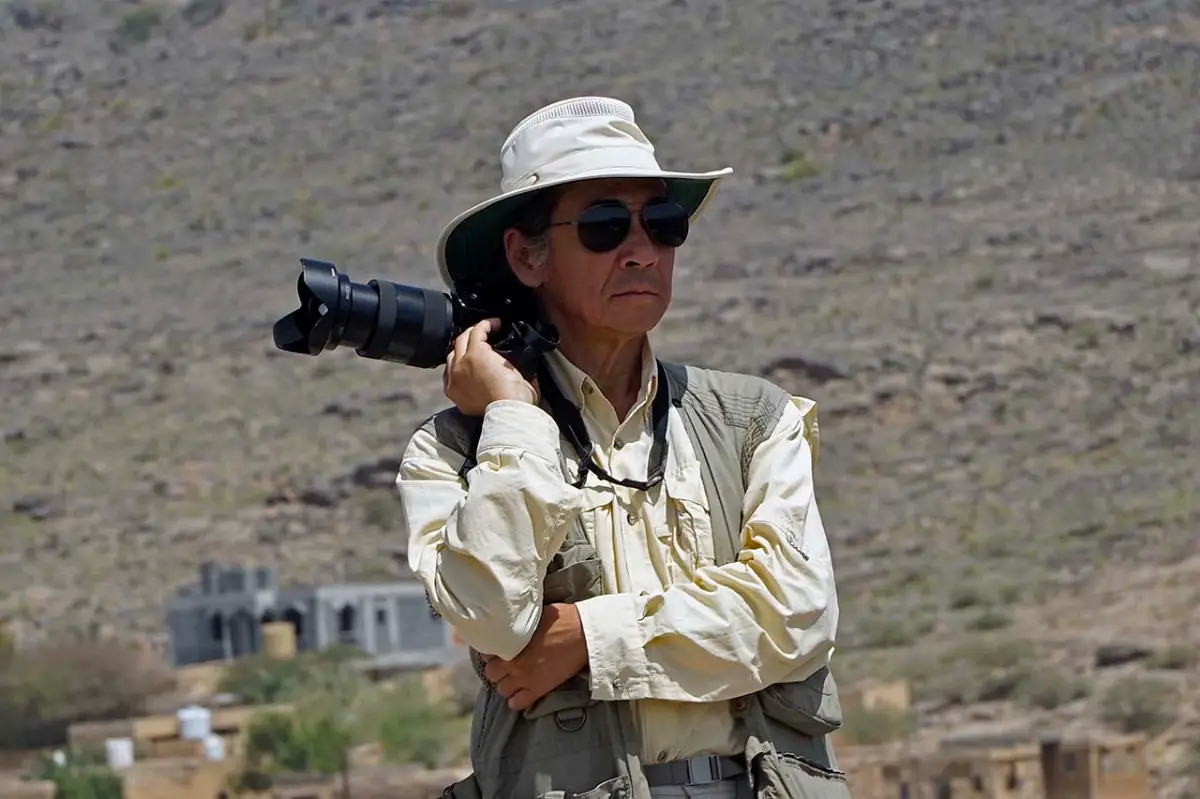
Tom with telephoto camera in Oman's desert Landscape
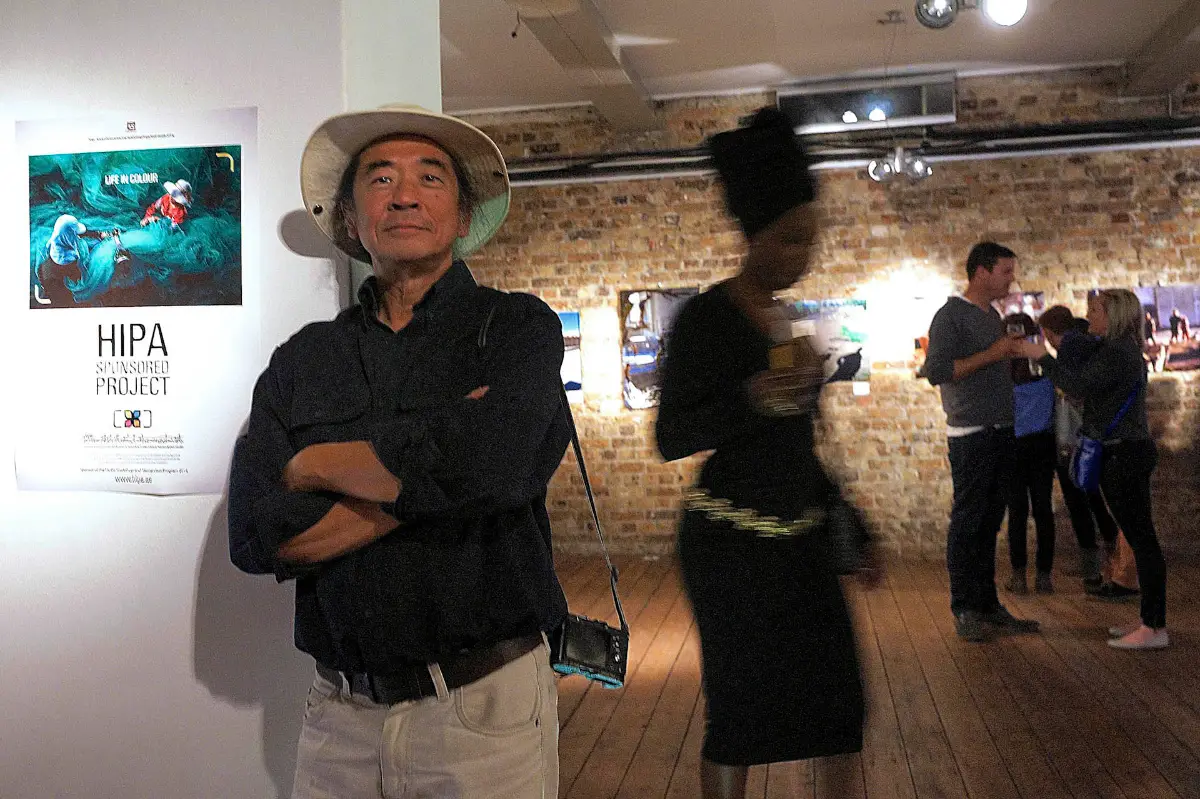
Tom Ang at the HIPA-sponsored exhibition opening.
The Practice
The method, as Ang explains it, is architectural before it is intuitive. He begins with a structure — a grid, a musical phrase, a branching root network — and then improvises inside it, mark by mark. The skeleton is planned; the skin is discovered. He compares it to composition in music: the key and the rhythm are fixed in advance, but the melody emerges in the playing, and sometimes breaks through the tonal frame entirely. What looks, at a glance, like exuberant complexity is in fact a deeply considered system — chaos entered with intention.
This is something Ang has had to learn to trust. His struggles, he says, have taught him above all that he must go his own way — that he is, by nature, a builder of multi-layered things, someone who uses structure to move through disorder rather than around it. Richness, he has found, almost always looks unresolved at first. For years that troubled him. Now he understands it as the nature of the work. Complexity, as he puts it plainly, is his native language. And repetition — returning again and again to the same questions of connection, rhythm, and meaning — is not stagnation but growth.
"Chaos is not something to be avoided — but something to enter with a clear yet flexible vision for some unknown thing beyond the horizon."
— Tom Ang
This philosophy extends to how Ang thinks about art's place in the world at large. In an era of compressed attention and accelerating information, he sees the work of art as a counter-pressure — a space for slow, contemplative looking in which complexity can be entertained rather than flattened. The connections his pieces make visible — between light and texture, between the photographic fragment and the calligraphic mark, between the natural world and the human hand — are precisely the kind of connections a rushed world tends to erase. Art, for him, is not decoration. It is restoration.
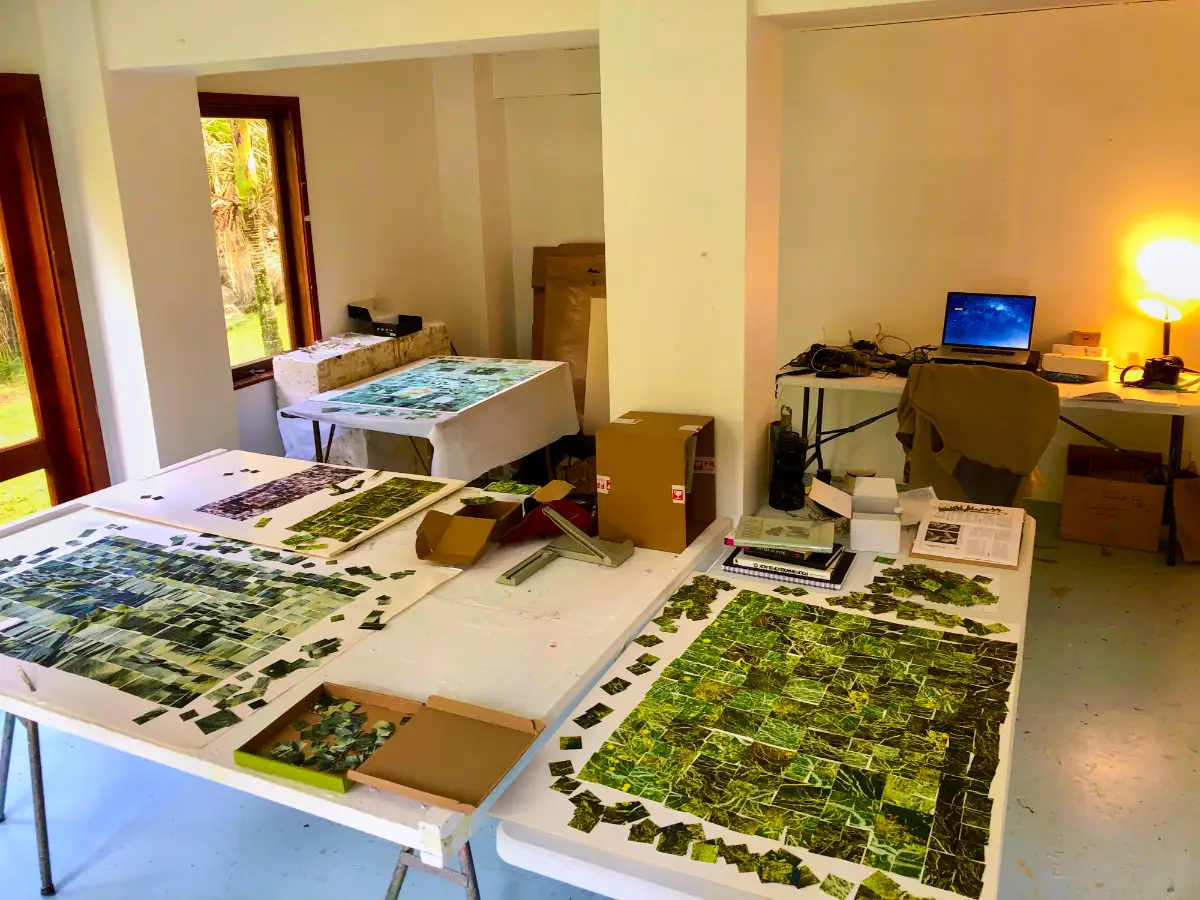
Ang composing a large-scale work in his studio — photographic prints arranged on the floor before final layering and assembly. The process can span weeks.
Living with the Work
For collectors, Ang has a specific vision of what ownership should feel like — and it is not the jolt of an immediate impression. He hopes for something closer to a slow friendship: a relationship that deepens over time, in which new details surface on a Tuesday morning that were invisible on the first day of hanging. He imagines his pieces as fields that reward re-entry — a glance from across a room that catches something different depending on the light, a moment of close study that reveals a fragment not previously noticed. He wants collectors to live with a quiet energy, a tranquility that is never quite still.
The legacy he imagines is of a piece with this hope. As millions of people live with his books — holding them on shelves, returning to them, lending them to friends — he would like as many to live with his images on their walls. More than individual works, he wants to leave an ethic: an argument, made in pigment and light, that even now, even at this pace, there is time to stand and stare. That the woven complexity of the natural world — its patterns, its connections, its inexhaustible depth — is available to anyone willing to look.
He has one word for what it means to be an artist. Service. To bring joy, awe, contemplation, awareness, and hope into people's lives. It is, when you think about it, the same instinct that sent a young man looking more closely at the world when he was unhappy in it. Fifty years later, the looking has not stopped. It has only become more deliberate, more layered — and far harder to look away from.
"I want to leave an ethic of awe and contemplation in a hyper-accelerated culture — encouraging collectors to find time to stand and stare."
Brushly - taking artists from "Studio to spotlight"