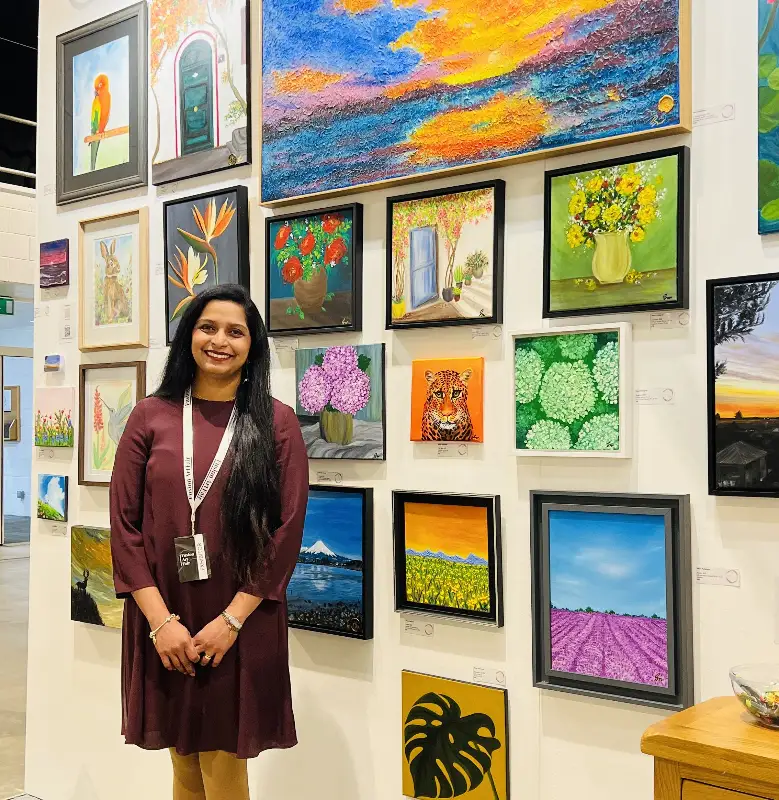
There are artists who arrive at their calling through rupture, and others through recognition. For Shree Nallapeta, art was never an interruption. It was a constant presence, waiting patiently alongside the rest of her life.
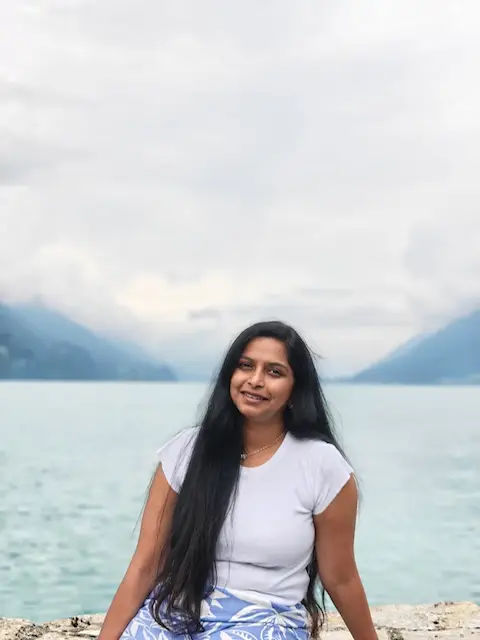
“Art has always been a quiet, constant presence in my life,” she reflects.
Long before the language of exhibitions or awards entered the picture, she felt drawn to colour, texture and form as one might be drawn to breath.
Originally from India and now based in Leeds, her visual language carries the intimacy of migration. It holds both the saturated memory of her origins and the softened light of Yorkshire skies. Between these geographies, her canvases unfold.
Parallel Lives
By profession, she is a pediatrician. By instinct, a painter. The two paths have never cancelled one another. Instead, they have evolved in tandem, sometimes in tension, often in harmony. Art, she says,
“has grown alongside my medical career — sometimes softly in the background, sometimes demanding to be heard.”
Time has been her greatest negotiation. Medicine, motherhood and creative practice converge within finite hours. She recalls periods of intense study and young children when “finding space for creativity felt especially difficult.” Yet even after long clinical days, she found herself returning to the canvas, not depleted but restored.
“I can spend hours immersed in a painting — completely absorbed, energised rather than exhausted.”
In this, art becomes not escape but equilibrium.
Matter and Memory
Nallapeta’s surfaces are not merely painted. They are constructed.
Clay is pressed directly onto canvas, shaped and sculpted before pigment is applied. The result is relief rather than flatness, an invitation to experience the work beyond sight alone. Texture interrupts the predictable. It insists on presence.
Her Tree of Life series has become a defining body of work. Through layered clay and luminous colour, the archetype is given new tactility. Growth becomes dimensional. Resilience becomes something that casts shadow.
The tree, in her hands, is not decorative. It is connective tissue. An emblem of continuity that resonates across cultures and private histories.
Intuition as Compass
“I work very intuitively,” she says.
Often, she dreams in color before she paints. Hues arrive fully formed in her imagination, demanding to be mixed with precision. Achieving the right tone is not merely technical. It is emotional calibration.
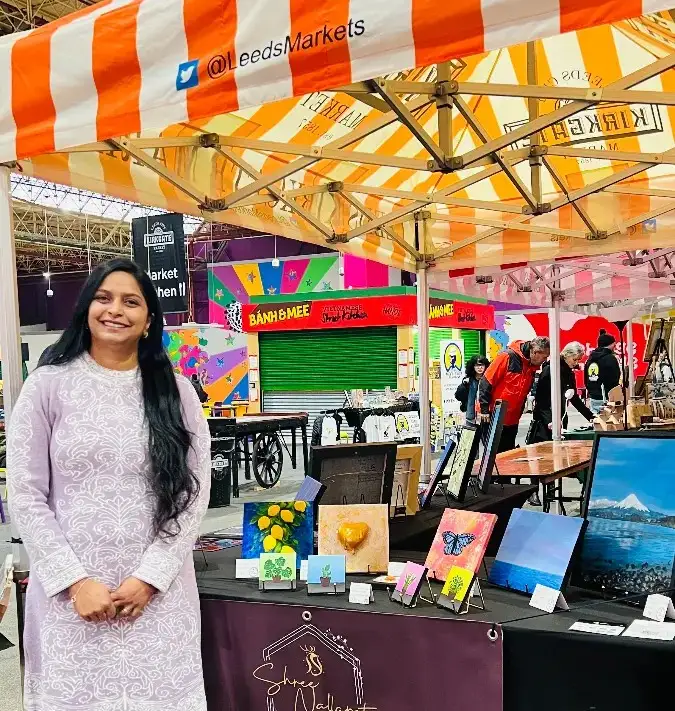
“It has to feel right as much as it looks right.”
Landscapes draw her with equal intensity. She studies their natural layout and light with care, seeking fidelity to what she experiences, yet never surrendering her expressive hand. Observation and intuition converse. Neither dominates.
Her process is not rigid. It is responsive. The canvas becomes a site of listening.
The Learning Curve of Visibility
As a self-taught artist, she has shaped her practice through experimentation and persistence. Paint and canvas offered little resistance. The professional world required different skills.
She speaks candidly about navigating exhibitions, visibility and the mechanics of presenting work publicly. It has been, in her words, “a very steep learning curve.” The making felt instinctive. The framing of that making demanded new forms of resilience.
Recognition has followed. Exhibitions across the United Kingdom, international collectors, accolades including Artist of the Year for 2025 to 2026. Yet when asked what she is most proud of, her answer shifts the frame entirely.
“More than awards, sales or praise, I feel most proud when someone believes my artwork is worth their hard-earned money, their time and a place within their home.”
To enter another person’s domestic space is, for her, the highest form of trust. A painting becomes part of daily life, woven into memory.
Recognition and Reach
Visibility unfolded steadily through fairs and galleries across the United Kingdom, including presentations at the Fusion Art Fair and the Harrogate Spring Fair. A defining moment came when her work was displayed within a London Underground station, where textured canvases met the rhythm of daily transit.
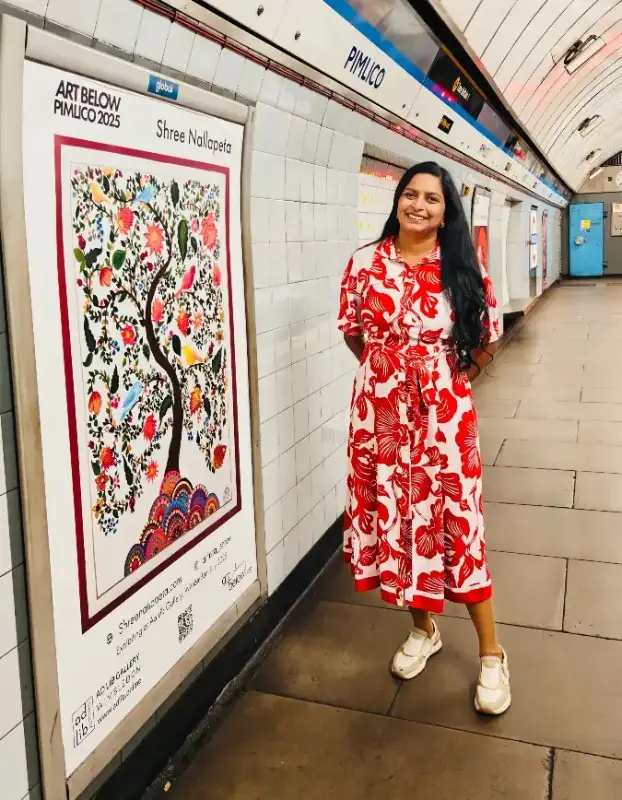
Her Tree of Life series extended that reach internationally. One piece resonated widely online, drawing millions of viewers and affirming the symbol’s enduring universality.
Formal recognition followed, including Artist of the Year for 2025 to 2026. Yet even in the presence of titles and public milestones, she returns to what feels most meaningful. A painting placed in someone’s home, she believes, is the truest form of honour.
The First Collector
Before fairs and features, there was her mother.
“She has proudly showcased the artwork I created as a child and teenager,”
Nallapeta recalls. Framed carefully, carried across house moves and changing interiors, those early works were preserved without condition.
This quiet faith predated any external validation. It remains foundational. In that private act of display, the artist was already seen.
Art as Continuance
When asked about the role of art in society, her response widens.
“I see art as part of the very purpose of life,” she says.
For her, art is not auxiliary to culture. It is its memory. It preserves feeling beyond the lifespan of fame or material wealth. “Long after recognition fades and material things lose their value, art continues to speak.”
There is a humility in this perspective. To create is to contribute something that may outlast the self. Not monumentally, but quietly.
The Canvas as Restoration
Nallapeta describes painting as an emotional recalibration.
“I have never felt sad while painting,” she offers. Whatever mood she carries to the studio dissolves in the act itself. The canvas absorbs noise and returns clarity.
Her hope is simple. That this lightness translates. That viewers sense the optimism embedded within the layers. That a moment of warmth moves from her hand into their space.
The Ongoing Horizon
Her ambitions are not framed by scale or spectacle. They are rooted in continuity.
“My hope is simple and heartfelt, to keep painting my heart out.”
Growth, experimentation and fearless expression remain central. If a single work speaks deeply to someone, if it lingers beyond the first encounter, she considers that enough.
To emerging artists, her advice is immediate.
“Start now. Do not wait for the right moment.”
Creation is not a future condition. It is a present act.
Shree Nallapeta’s journey unfolds one canvas at a time. In layered clay and saturated pigment, she constructs spaces where resilience takes shape and colour becomes architecture.
Art, for her, is not separate from life. It is how she moves through it.