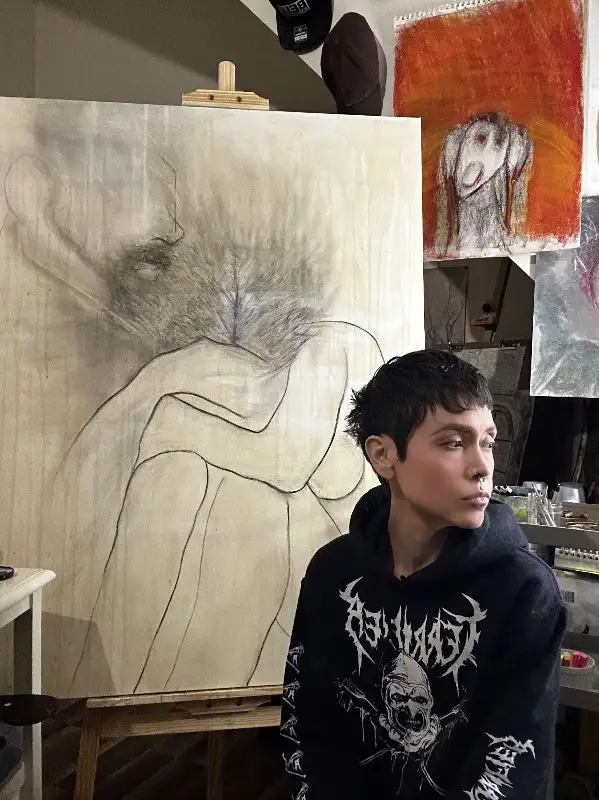
Christina Ivette Jimenez did not arrive at her artistic voice through institution alone. Though she studied at the Art Institute of New York City for two years, acquiring technical foundation and formal discipline, the true formation of her language occurred elsewhere. It unfolded through lived experience, independent research, and nearly two decades of sustained practice.
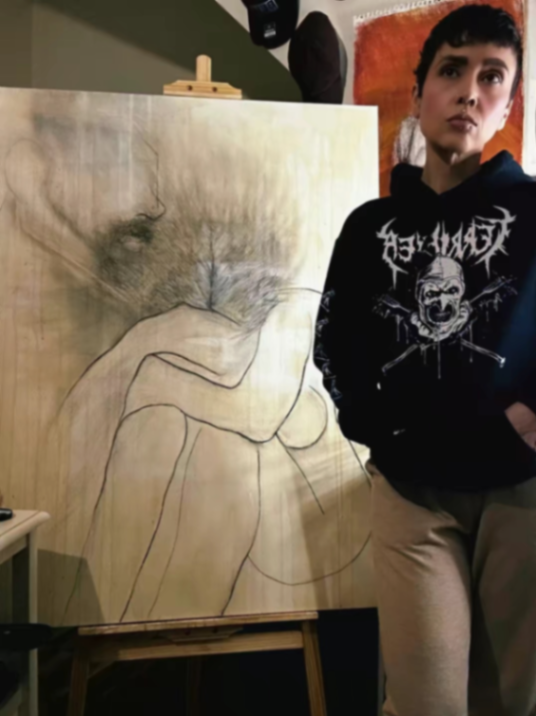
Her education expanded beyond classrooms into psychological inquiry, material study, and prolonged self observation. She learned not only how to apply pigment or prepare a surface, but how to listen. Listening became method. Material became interlocutor.
Her work emerges from internal landscapes shaped by identity, fragmentation, and silence. Periods of emotional intensity and psychological unrest did not merely inform the art. They necessitated it. Art became documentation and survival. A means to externalize what language could not contain.
Over time, survival transformed into intention. Texture became memory. Layering became history. Structural tension became the architecture of the psyche.
Her voice today is quiet yet weighted. Fragmented yet deliberate.
Material as Memory
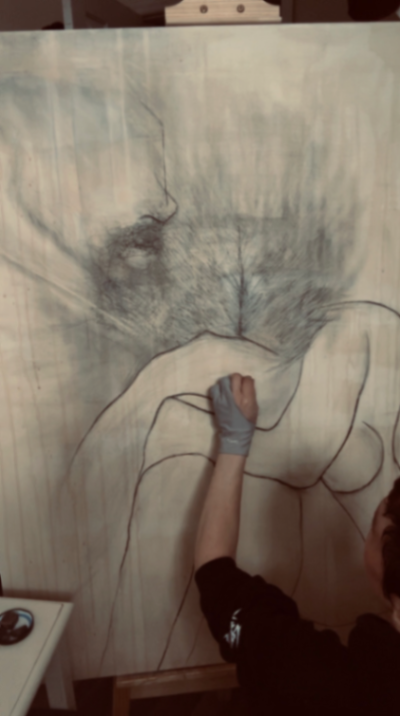
Jimenez works primarily in mixed media on large scale canvas. Each surface begins with preparation. Gessoed grounds are stained, sometimes with unconventional substances such as coffee, creating an aged patina that suggests something already lived.
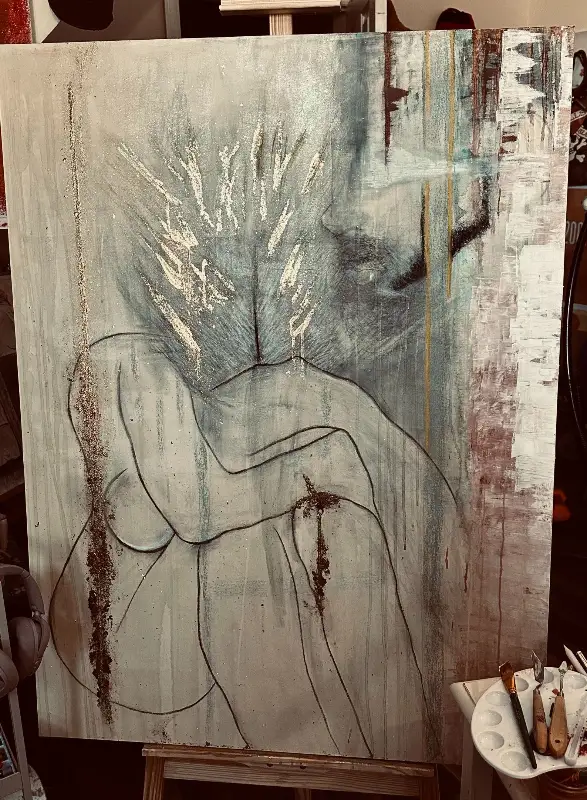
From that ground she builds with acrylic, charcoal, pastel, graphite, collage elements, and occasionally metallic leaf. Each medium performs a distinct role. Charcoal carries immediacy and rawness. Acrylic provides structure and permanence. Pastel introduces softness. Gold leaf interrupts the surface with a tension that feels almost sacred.
No single material can contain the complexity she seeks to express. The interplay between absorption, resistance, cracking, and blending mirrors emotional states. The surface becomes a site of excavation.
In her words, “The materials are not just tools. They become metaphors.”
Layering is not decorative. It is psychological.
Structured Intuition
Her process resists rigid premeditation. There is rarely a fixed sketch or predetermined conclusion. Instead, she prepares the surface until it holds history, then responds to it.
“I work intuitively but not without intention,” she explains.
This intuition is informed by decades of study and experience. Composition, structural tension, and material behavior form an internal framework. The work may appear spontaneous, yet it is anchored in understanding. She describes it as structured intuition.
There is a negotiation at the heart of each canvas. Control and surrender move in quiet opposition. Push and pause. Build and withhold.
Often the finished work reveals something she did not consciously plan but something she needed to uncover.
The Uneven Path
Her journey has not been smooth. It was not meant to be.
Personal and psychological challenges shaped both her identity and her visual language. There were periods of instability and rebuilding. Moments when art was less career and more necessity.
Those obstacles did not derail her practice. They defined it.
The fragmentation visible in her work is not theoretical. It is lived. The tension is not aesthetic device. It is memory embedded in structure. She credits the unevenness of her path with giving her depth and resilience. The lack of reliance on external validation strengthened the integrity of her voice.
What remains is work that feels unpolished in the most deliberate sense. Honest rather than comforting.
Resilience as Achievement
When asked what she is most proud of, her answer is not exhibition history or critical recognition. It is endurance.
Sustaining a nearly twenty year professional practice through personal and emotional challenge is, for her, the true accomplishment. Continuing when it would have been easier to abandon the pursuit required a commitment that surpasses ambition.
She also speaks of independent study as formative. Expanding beyond her foundational education through research in art history, psychology, and material behavior allowed her practice to mature into something self defined.
The evolution from raw survival into intentional exploration marks a turning point. Works such as The Weight of Quiet embody not only technical refinement but personal integration.
Integrity remains the central measure. She has never created for trend or approval. She creates from necessity and truth.
Fragmentation as Human Condition
Jimenez does not position fragmentation as failure. She sees it as evidence of depth.
“I hope my work conveys that fragmentation is not failure. It is part of being human.”
Her surfaces speak to private battles carried quietly. The layering and tension create spaces where vulnerability feels dignified rather than exposed. She does not dictate emotion to the viewer. Instead, she offers permission. Permission to exist in complexity. Permission to remain unfinished and evolving.
The work unfolds slowly. It resists instant clarity.
The Introspective Collector
Her ideal audience is not seeking decoration. It is someone drawn to emotional and psychological resonance.
She speaks of collectors who recognize themselves in texture and subtle shifts in tone. Those who see art as dialogue rather than possession. Individuals who sit with a piece, allowing it to evolve in meaning over time.
Quiet, in her practice, is not absence. It is presence held in restraint.
Toward Immersive Architecture
Looking forward, Jimenez envisions expansion. Larger scale. Immersive environments rather than singular canvases.
She is interested in emotional architecture. In creating spaces where structural tension and silence can be experienced spatially, not only visually. Her material exploration will continue to refine, incorporating metallic elements and distressed surfaces while deepening the psychological narrative.
She imagines cohesive bodies of work functioning as chapters. Series that explore evolving dimensions of identity and internal landscape. Institutional contexts where dialogue between works becomes as significant as each individual surface.
For her, there is no definitive arrival. Only ongoing excavation.
A Way of Existing
“Being an artist is not a title. It is a way of existing.”
For Christina Ivette Jimenez, art is inseparable from life. It is how she processes silence, tension, and what lies beneath the surface. It is a commitment to honesty over comfort, depth over decoration, vulnerability over performance.
To be an artist is to refuse to look away. To confront. To layer. To build. To leave space.
Her canvases do not shout. They hold weight. They hold memory. They hold the quiet architecture of resilience.
In that architecture, viewers may find not answers, but recognition.