Three weeks into a pet portrait, the client messages: "Could you make him look a bit younger? Also, my sister wants mugs of it for Christmas." You never agreed to either. You also never agreed not to.
A commission contract is the page that settles those questions before anyone asks them. It names you and the client, describes the piece, fixes the price and the deposit, sets the timeline and the number of revisions, says who may reproduce the work, and explains what happens if either of you cancels. Below is every clause a commission contract needs and the argument each one prevents, a template you can copy tonight, and a way to draft a branded version from your own details in a couple of minutes. Nothing here is legal advice, and contract law differs from place to place, so for large or unusual commissions it's worth having a local lawyer check your template once.
Every clause, and the argument it prevents
Most commission disputes start with something nobody wrote down. Each clause closes one of those gaps.
| Clause | What it says | The argument it prevents |
|---|---|---|
| Parties and date | Your name and the client's, with contact details and the date | Who owes whom, especially when one person orders a gift for another |
| The work | Subject, medium, size, what the client supplies, framed or unframed | "I thought it would be bigger" |
| Price and payment | One agreed price, the deposit, when the balance is due, how to pay | Chasing the balance after the painting has left your studio |
| Timeline | What starts the clock, the estimated delivery, what pauses it | Delays blamed on you while you wait for the client to reply |
| Revisions | How many rounds, at which stage, what counts as minor, the fee for more | Endless "one last tweak" requests |
| Copyright and use | You keep the copyright; personal or commercial use; your right to show the work | The portrait turning up on merchandise |
| Cancellation | What happens to the deposit, part-payment for work done, what happens if you cancel | Refund arguments halfway through |
| Delivery | Shipping or collection, who pays, insurance | Who's responsible when a parcel arrives damaged |
| Communication | How you'll keep in touch and how quickly you reply | Late-night "any update?" messages |
| Disputes | Talk first, then mediation, and which place's law applies | Not knowing what to do when talking fails |
| Signatures | Both of you sign and date | "I never agreed to that" |
On a small, quick sketch the last three can be a single line each. On anything expensive, or when the client is a business, give them their own clause.
A commission contract template you can copy
Fill in the brackets, delete what doesn't apply, and send it as a PDF with your quote. It's written in plain English on purpose. A client who understands the terms is much less likely to argue with them.
Parties. This agreement is between [artist name] ("the Artist") and [client name] ("the Client"), dated [date].
The work. The Artist will create [subject, medium and size], based on [reference photos supplied by the Client], delivered [framed or unframed].
Price and payment. The total price is [amount], plus [shipping and any tax]. A deposit of [50%, amount] is due before work begins and becomes non-refundable once [the sketch is approved]. The balance of [amount] is due [on approval of the finished work, before delivery], by [bank transfer or card].
Timeline. Work begins when the deposit is received. Estimated completion is [four weeks]. The timeline pauses while the Artist waits for approvals or information from the Client.
Revisions. The price includes [two] rounds of minor changes to colour, expression or detail, made at the sketch stage and on the finished work. A new composition or subject is a new commission. Further changes cost [rate].
Copyright and use. The Artist keeps the copyright. The Client may display the work and share photos of it for personal, non-commercial purposes. Commercial use needs a separate written licence. The Artist may show the work in their portfolio and on social media [unless the Client asks otherwise].
Cancellation. If the Client cancels, the Artist keeps the deposit and is paid for work completed beyond it. If the Artist cancels, all payments are refunded in full.
Delivery. The work will be [shipped insured or collected] by [date]. Shipping costs are [included or billed separately].
Signatures. Artist: [name, signature, date]. Client: [name, signature, date].
Drafting a branded contract with Brushly
Filling in brackets for every client gets old, and it's easy to miss one. Brushly's Commission Contracts tool, one of the Palette tools, asks for the details once and drafts the whole agreement.
You start by choosing the commission type from ten options, from portraits and pet portraits to logo, character and product design. Then you add your name, the client's name and a description of the piece. Next come the money and the timing: a price range, or Custom Pricing if you'd rather type your own. You also pick the payment terms (50% upfront and 50% on completion, 100% upfront, 25% and 75%, three stages, monthly instalments, or a plan of your own) and the deadline. Finally you set how many revisions are included, from one to unlimited, and decide on one checkbox: whether to grant the client commercial use rights. Leave it off and the contract limits them to personal use. Your studio logo appears at the top of the contract and the PDF.
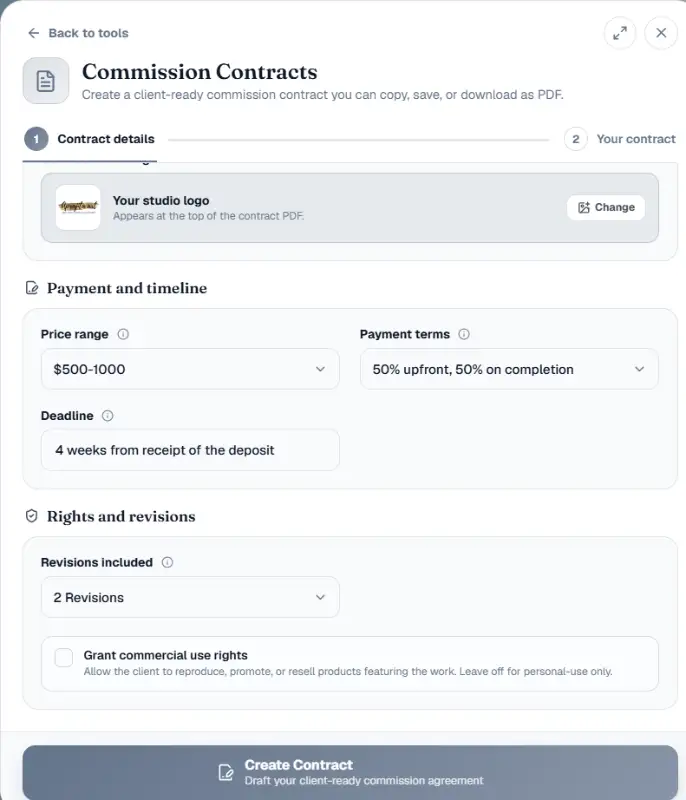
For our test commission, a fictional artist, Maya Torres, painting a 16 × 20 inch acrylic portrait of Jordan Reyes's dog with a 50% deposit, two revisions and personal use only, it drafted an eleven-section agreement. The sections covered the parties, the project, the timeline, payment terms, revisions, copyright and usage rights, cancellation, delivery, communication, dispute resolution and signatures. It carried every choice through, including starting the four-week clock from the deposit and limiting the client to personal use.
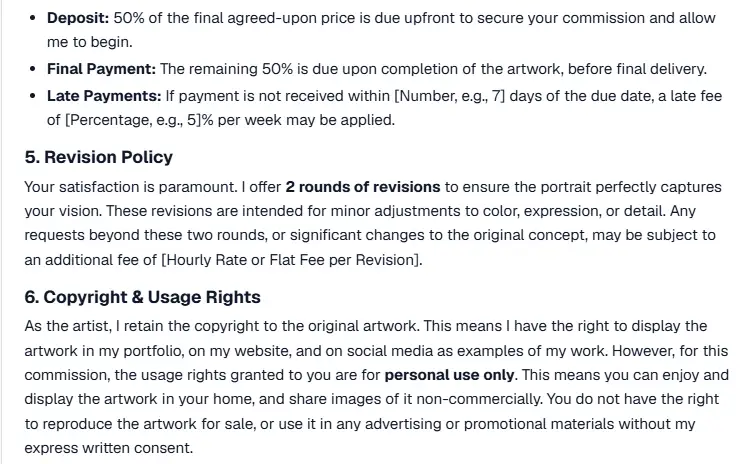
You can edit the contract in place, copy the text, or download it as a PDF with your logo at the top. If the first version isn't right, Regenerate takes a quick instruction: make it simpler, make it shorter, make it more protective for the artist, or clarify the usage rights.
Read the draft before it goes anywhere, as you would any template. Ours left brackets for both addresses, the late-fee percentage, the shipping carrier and which place's law applies. It gave the price as the range we'd picked, "between $500 and $1000, to be finalized", so replace that with the exact figure you quoted. The voice was warmer than a contract needs ("I pour my heart into each piece"), and lines like that can go. It also ended by calling itself a legally binding document. Whether it is depends on where you and your client live, so treat that sentence as something to check, not a promise. Ten minutes of edits gets you a contract you'd be happy to sign. The tool is included on Brushly's Professional plan and in the free trial.
Selling the painting doesn't sell the copyright
The clause artists skip most is the one that matters most once a piece gets popular. When a client buys a commissioned painting, they own the object. In many countries, including the US and the UK, the copyright stays with the artist unless the artist signs it over in writing. By default, the client can hang the painting and post photos of it, but not print it on mugs, sell posters of it or use it in an advert.
Write it down anyway. Most clients don't know the default, and one clear sentence saves an awkward conversation later. If a client does want commercial use, for a shop sign, a book cover or merchandise, that's a licence, and it's normal to charge for it on top of the painting. Say what they may use it for, where, and for how long.
Keep the right to show the work yourself, too. A finished commission, shared with the client's blessing, is some of the best material for your online portfolio, because the next client wants to see what the last one got.
Five gaps to close before you send it
These turn up again and again, even in good templates.
A price range instead of a price. "Between $500 and $1,000" invites a negotiation after the work is done. Quote one number.
"Revision" left undefined. A different background colour is a revision. A different pose, or a second dog, is a new commission. Say which is which.
No moment when the deposit stops being refundable. Tie it to something both of you can see, such as sketch approval or the day you start painting.
A clock that never stops. If the client takes two weeks to approve the sketch, your deadline should move by two weeks. The contract should say so, or you'll be the one who's late.
Shipping left vague. Say who pays for postage and insurance, and what happens if the parcel arrives damaged.
After the client signs
Send the deposit invoice the same day, while the yes is fresh. Brushly's invoices record the deposit as a partial payment, so the balance due is clear when you deliver. When the piece ships, include a certificate of authenticity with the size, medium and date, so the client has a record of the original they commissioned. Keep the signed contract with your records. If a question comes up a year later, you'll want to find it in a minute, not dig through old messages.
Quick answers
Do I need a contract for a small commission?
For a $60 sketch, a short email listing the price, deposit, revisions and delivery date, which the client replies to with "agreed", does most of the job. Once a commission is worth more than you'd be happy to lose, use a full contract.
Is a commission contract legally binding?
That depends on the law where you and the client are. What a signed contract always gives you is a clear record of what you both agreed, which settles most disagreements long before anyone thinks about court.
What's the difference between commission terms of service and a contract?
Terms of service are your general rules for every commission, usually published on your website or price sheet: deposits, revisions, turnaround and what you won't take on. A contract applies them to one job, with this client, this piece and this price, and both of you sign it. Many artists attach their terms of service to each contract so they don't have to rewrite them.
Send your next commission with the terms agreed before the first brushstroke. Every new Brushly account comes with a 7-day free trial, so open Brushly, draft a contract for the commission you're quoting now, and edit it until it sounds like you. The plans page shows which tools each plan includes.