"Just drop the paintings off, we'll sort out the paperwork later." Six months on, two of your five paintings have sold, one is "somewhere in the back", and the payment you were expecting will arrive "with the next batch". Nobody is being dishonest. There's simply nothing written down to check against.
An art consignment agreement is the contract between you and a gallery, shop or dealer that sells your work on your behalf. You usually keep ownership of each piece until it sells, and the gallery takes an agreed commission from the sale. A good agreement lists every piece and its price, sets the commission, says when and how you'll be paid, who insures the work, who pays for framing, shipping and promotion, whether you can sell elsewhere, how long it lasts, and how unsold work comes back. This isn't legal advice, and consignment rules differ between countries and states, so have anything unusual checked locally. Below: every clause and why it matters, the questions to ask before you sign, the red flags, and how to keep your consignment records straight.
The clauses, one by one
| Clause | What it should say | Why it matters |
|---|---|---|
| Parties and dates | Your name, the gallery's legal name, the start date | Who is responsible for what, from when |
| Consigned works | A signed list of every piece: title, medium, size, retail price, condition | The record you'll check everything against |
| Ownership | The work stays yours until it's sold and paid for | Protects your work if things go wrong |
| Retail price | The agreed price of each piece, and who can change it | Stops quiet discounting |
| Commission | The gallery's percentage of the sale price | Your share, in writing, before anything sells |
| Discounts | Whether discounts are allowed, how much, and who absorbs them | A "10% collector discount" shouldn't come only out of your share |
| Payment | How soon after a sale you're paid, and how | "Within 30 days of the sale" is clear; "periodically" isn't |
| Sales reporting | How and when the gallery tells you what sold, to whom, for how much | You can't check a payment you don't know about |
| Insurance | Who insures the work in the gallery and in transit, and for what value | Damage and theft happen |
| Costs | Who pays for framing, shipping, photography, promotion and openings | These can quietly eat your share |
| Exclusivity | Whether you can sell the same work, or any work, elsewhere, and where | Protects the gallery without trapping you |
| Term and termination | How long it runs, how either side can end it, with how much notice | Avoids work sitting there indefinitely |
| Return of unsold work | Who pays to return it, and in what time frame | The part most often forgotten |
The consignment list is the heart of it
Everything else in the agreement refers back to one document: the list of consigned works. For each piece, record the title, year, medium, size, the agreed retail price, your share at the agreed commission, and its condition when it left your studio, ideally with a photo. Both of you sign and date it.
Update it every time something changes: a new piece goes in, one sells, one comes back. A list signed in March is only useful in September if it has been kept current in between.
Check in every month
A consignment can drift quietly out of step with reality, so give it ten minutes each month.
Compare lists. Ask the gallery for its current list of your work and check it against yours, piece by piece. Anything on your list but not theirs needs an answer now, not at the end of the term.
Match sales to payments. For every piece marked sold, check that you've been told the sale price, the date, and when your share is due. Chase anything overdue politely, in writing, and keep the reply.
Ask what's moving. Which pieces get attention, which are sitting in storage, and whether a different size or subject would sell better. Galleries see buyers you never meet.
Swap slow work. If a piece hasn't been hung in months, ask to replace it with something new. Fresh work gives the gallery a reason to contact its collectors again.
Questions to ask before you sign
What happens with a discount? Is it taken from the gallery's commission, from your share, or split?
What about sales you make yourself? If a collector who saw your work at the gallery buys directly from your studio, does the gallery expect a commission?
How will you report sales? A monthly statement is a reasonable thing to ask for.
What if the gallery closes or changes hands? Ask how your work would be returned. In some places consigned art has specific legal protection, so check the rules where you live.
Who decides how the work is shown? Hanging, storage, and whether it's taken to fairs on your behalf.
Can I see the space where unsold work is stored? It tells you a lot about how it will be treated.
Red flags
Be cautious if a gallery won't put the terms in writing, charges you a fee to hang your work, is vague about when you'll be paid, wants to set or change prices without asking you, or asks for long exclusivity over a wide area when it hasn't sold your work before. None of these always means trouble, but each is worth a direct question before you sign.
Tracking consigned work with Brushly
The agreement tells you what should happen. Your records tell you what has. Brushly's inventory doesn't produce a consignment agreement, but it keeps exactly the records one depends on.
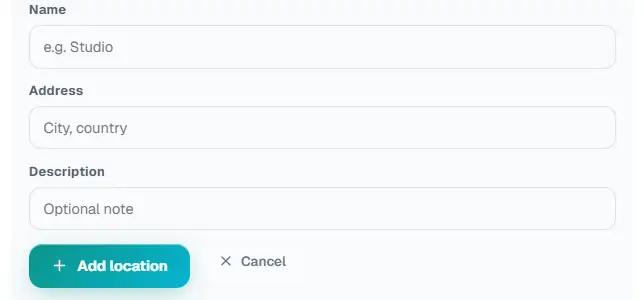
Add each gallery as a location, with its name, address and a note such as the agreement's start date or commission. Then move each consigned piece to it. Every piece carries a status (available, reserved, sold, on display, in transit or damaged), so you can see at a glance what's hanging, what's travelling and what has sold.
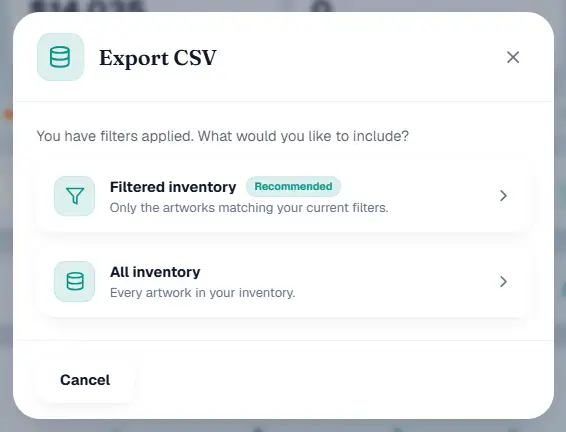
To produce your consignment list, filter the inventory to that
gallery's location and export it as a CSV: title, details and price for every piece there, ready to tidy, attach to the agreement and sign. You can export just the filtered view or your whole inventory. The inventory report also breaks your stock down by location, which is a quick way to reconcile against the gallery's own statement each month.
When a piece sells, mark it sold so the record is right, and if the gallery asks for one, send them an invoice for your share through Brushly's invoicing. Offer the buyer a certificate of authenticity, with its own serial and QR code, so the original is documented from its first sale.
When work comes back
At the end of the term, or when you swap work out, check each returned piece against the signed list: the title, the condition, the frame. Photograph anything that has been damaged and raise it straight away, while the insurance clause still applies. Then move the piece back to your studio location, so your records show where it really is, and it's ready to list on your online portfolio or send somewhere new.
Quick answers
Who owns artwork on consignment?
Usually you do, until the piece is sold and paid for. The agreement should say so explicitly.
What commission do galleries take on consignment?
It varies widely between galleries, cities and types of work. Ask for the exact percentage, and get it in writing before any work is delivered.
How long should a consignment agreement last?
A fixed term, such as six or twelve months, with the option to renew, gives both sides a natural point to review what's selling.
Do I need a consignment agreement for a café or shop?
Yes. Any time your work is in someone else's space and they're selling it for you, a short written agreement and a signed list protect you both.
Keep your consigned work accounted for, piece by piece. Every new Brushly account comes with a 7-day free trial, so open Brushly, add your galleries as locations, and export an up-to-date consignment list whenever you need one. See the plans for what's included.