You finished a 16 × 20 inch painting last week. Someone on Instagram asked how much it is. You typed $300, deleted it, typed $650, deleted that too, and replied "let me get back to you."
That pause is the part most art pricing advice skips. Formulas are easy to find, and every one of them produces a number. What they don't give you is a number you believe, or a sentence to send back when the buyer asks why it costs that much.
So here is one painting, run through every popular pricing formula with the math shown. Then what a price actually has to account for, and a calculator that does that work and explains itself.
The painting we're pricing
A 16 × 20 inch acrylic on canvas. Materials came to $65: canvas, paint, medium and varnish. It took 14 hours over two weeks. The artist has been painting seriously for about three years, has a recognizable style, and has sold a handful of originals, mostly to people who found her online. She wants her time to be worth at least $25 an hour.
Nothing exotic. Most working artists will recognize these numbers.
Four ways to price art, on the same canvas
| Method | Formula | Price for this painting |
|---|---|---|
| Hours plus materials | (hours × hourly rate) + materials | $415 |
| Double the materials | (materials × 2) + (hours × hourly rate) | $480 |
| Square inch | height × width × rate per square inch | $320 at $1, $480 at $1.50, $960 at $3 |
| Linear inch | (height + width) × multiplier | $360 at 10, $540 at 15 |
Same painting, same week, and the answer runs from $320 to $960 depending on which method you trust. None of the math is wrong. Each method just leaves out something different.
Where each art pricing formula breaks
Hours plus materials is where most beginners start, and it gives you an honest floor. $415 is what this painting cost to make if your time is worth $25 an hour. There is no margin in it, though, and nothing for the studio, the brushes you'll wear out, the framing, or the evening you spent photographing and posting the piece. It also rewards slowness. A painter who takes 30 hours on a canvas like this gets to charge twice as much as one who takes 14, and no collector will ever follow that logic.
Doubling the materials is a retail habit borrowed for art. It helps a little with the missing overhead, but on a painting where materials are $65, it barely moves the number.
Square inch pricing has one real strength, which is consistency. When every piece in a series is priced at the same rate per square inch, a buyer comparing a small canvas to a large one sees a logic they can follow. The trouble is that the formula hides the actual question inside the rate. Pick $1 and you're at $320. Pick $3 and you're at $960. The calculator can't tell you which rate is yours. It also underprices small, detailed work and overprices big, loose pieces.
Linear inch pricing, height plus width times a multiplier, behaves the same way with gentler jumps between sizes, and the same unanswered question sitting in the multiplier.
Galleries lean on a fifth method: comparing your work with similar artists at a similar stage. It's the most realistic of the lot and the hardest to do well, because the prices you can see on Instagram and Etsy are asking prices. What anything actually sold for is rarely public.
What a price actually has to cover
A price you can defend is built in layers, and each formula above covers one layer at most.
The bottom layer is cost: materials plus your hours at a fair rate. For our painting, $415. Charge less than that and you are paying to make art.
On top of cost goes margin, usually somewhere between 30 and 50 percent, because the painting has to pay for things that aren't on its receipt. Studio space, tools, marketing time, and the pieces that don't sell all come out of it. That takes our painting to roughly $540 to $620.
Then come two adjustments the formulas never make. The first is experience. An artist three years in with a developed style shouldn't be pricing like someone in their first year. The second is medium and size: what comparable acrylics at 16 × 20 actually sell for, which puts a ceiling on how far the other layers can push.
Last is strategy. The right price for a piece you need to sell at this weekend's fair is different from the right price for a piece you're happy to wait six months on. One number can't cover both.
This is the calculation most artists put off. It takes an hour, a spreadsheet, and more confidence about your own work than most of us have on a Tuesday night.
An art pricing calculator that shows its working
The Smart Pricing Calculator is one of the Palette tools in Brushly, and it works through exactly those layers.
You give it six things: what you spent on materials, how many hours the piece took, the hourly rate you want, the finished size in inches or centimeters, the medium, and your experience level, from beginner to professional. For a piece that's already in your Brushly studio, it looks at the artwork itself too, and fills in the size and medium from the artwork's details. For a commission, or anything you haven't uploaded, you price it from the numbers alone.
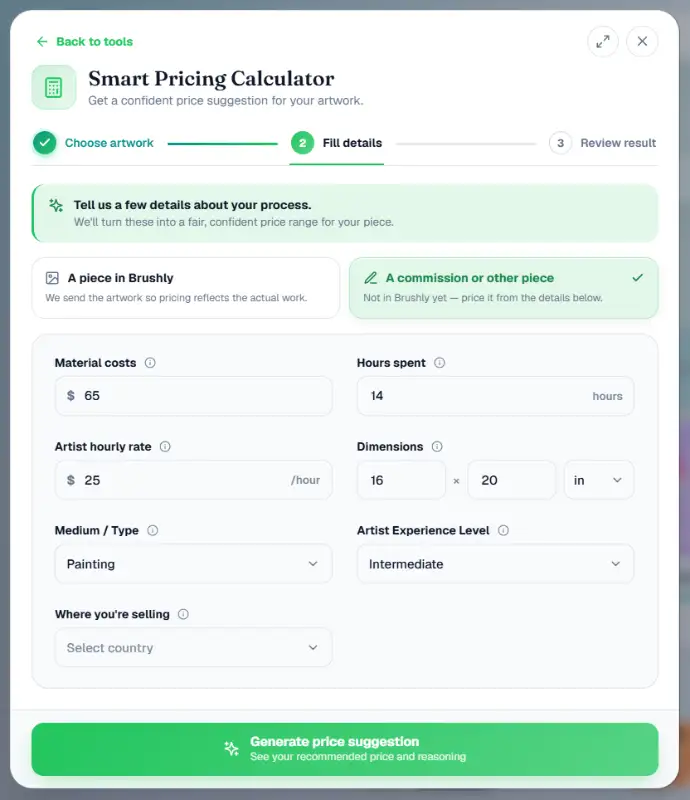
What comes back has three parts.
First, a number to list at, with a range around it, so you know how much room you have.
Second, three prices for three situations: a conservative price for a quick sale, a market price for your normal listing, and a premium price for a patient sale or a gallery wall.
Third, a written justification in five short parts: the cost floor, why your experience earns a premium, how the medium and size affect the price, whether the price holds up against the market, and whether it leaves you a sustainable profit. This is the piece no square inch calculator gives you, and it's the one you'll use most. When a buyer asks why the painting costs what it does, the answer is already written, in plain words, from your own numbers.
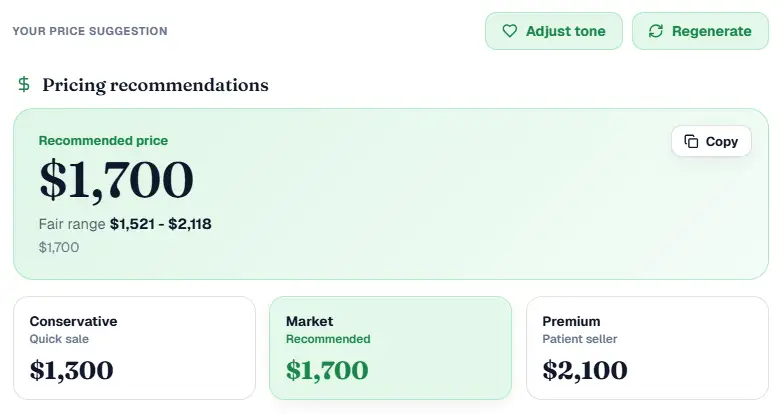
For our 16 × 20 painting, it came back with $1,700 to list at and a fair range of $1,521 to $2,118. The three situational prices were $1,300 for a quick sale, $1,700 at market, and $2,100 for a patient seller.
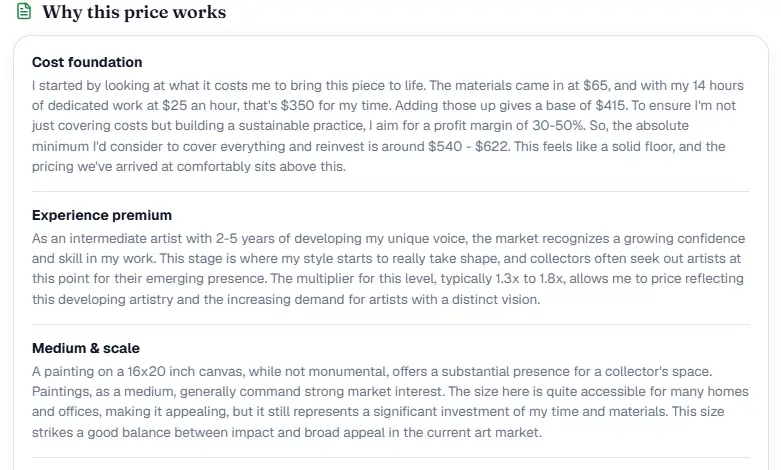
That's well above everything in the table, and the reasoning shows the steps it took. It starts from the same $415 cost floor we worked out by hand and adds a 30 to 50 percent margin to reach $540 to $622. Then it applies a premium for an intermediate artist (it states a range of 1.3 to 1.8 times for that stage) and weighs the medium and the size. Those premiums are where it parts ways with the formulas, and they're the part worth checking against what you've actually sold.
The reasoning is written in the first person, so it reads like you explaining your own price. The cost section opened with this:
"I started by looking at what it costs me to bring this piece to life. The materials came in at $65, and with my 14 hours of dedicated work at $25 an hour, that's $350 for my time."
You don't have to take the top number. If you sell at weekend markets where $1,700 would sit unsold, the $1,300 quick-sale figure exists for exactly that. Whichever price you pick, you know what it covers and can say so.
If a suggestion feels off, you can ask it to recalculate with a nudge: aim a bit higher, keep it more affordable, add the framing cost, or price it for gallery buyers.
Pricing a commission before it exists
Commissions are the hardest pricing problem, because you're quoting for hours you haven't worked yet. The same layers apply. Estimate your hours generously, since first estimates almost always run short, add materials, and run it through the calculator with the commission option selected. You'll have a quote and a reason before you reply.
Once your commission prices settle, the same Palette has tools for answering commission inquiries, building a rate sheet and drafting the commission contract, so the price, the reply and the paperwork all come from one place.
Once you have the number
Keep it the same everywhere. A collector who sees a painting at $600 on your website and $450 at a fair stops trusting both numbers. If a gallery takes 40 or 50 percent, your retail price there should match what you charge direct, which is one more reason to sell from your own portfolio with 0% commission and keep the whole margin when a buyer comes to you.
Put the price where buyers can see it. Brushly's inventory tracker keeps each piece's price with its record and prints price lists for art fairs, so the number on the wall matches the number in your books. When the piece sells, Brushly's sales tools turn it into a proper invoice.
Give a higher price something to stand on. A certificate of authenticity with a verifiable QR code tells a buyer at $600 that they're getting a documented original. A real title helps too, since "Untitled 14" does nothing for anyone. If naming is where you stall, Brushly's Artwork Title tool will give you options to start from.
And raise your prices when the work starts moving. When most of a series sells within a few months, the price was probably low.
Quick answers to common pricing questions
How much should I charge for a 16 × 20 painting?
It depends on how established you are and who's buying, which is why size charts disagree so wildly. For the painting in this post, the formulas landed between $320 and $960, and the calculator suggested $1,300 for a quick sale up to $2,100 for a patient one. If your sales so far sit well below that, start near the conservative figure and move up as pieces sell.
How do I price art as a beginner?
Start at the floor: materials, a modest hourly rate, and a margin on top. Then price similar pieces the same way. Beginners rarely get into trouble by being consistent. They get into trouble by pricing each piece on mood, which turns every sale into a negotiation.
Should I price my art by the square inch?
Use it once you already have a price you trust. Price one piece properly, divide that price by its square inches, and use the rate to keep the rest of the series consistent. A rate picked out of the air is a guess with extra steps.
Should prints cost less than originals?
Yes, by a wide margin. A print is a different product with a different cost, priced from what it costs to produce plus your markup. Keeping prints well below your originals protects the value of the originals, and that's where your pricing reputation lives.
Your next painting is the easiest place to start. Every new Brushly account comes with a 7-day free trial, so open the Smart Pricing Calculator, put in the numbers from the last piece you sold, and see whether the price you charged holds up.

