The gallery's email is friendly and short: "Could you send us a brief bio for the press release? By tomorrow, if possible." You have an artist statement, a CV and a line on Instagram. None of them is a bio, and suddenly you're not sure what is.
An artist bio is a short paragraph of facts about you, usually written in the third person: who you are, what you make, where you're based, and the milestones that make you credible. It isn't your philosophy (that's the statement) and it isn't every show you've ever been in (that's the CV). Below are artist bio examples for four kinds of artist, each in a short and a long version, a template you can fill in tonight, and a quicker way to get a first draft from your own details.
What goes in an artist bio
Most good bios follow the same order, because it's the order a stranger needs the information in.
Name, medium and place. "Sam Rivera is a painter based in Tucson, Arizona."
What you make, in one plain sentence. Subject, material, scale or approach.
Background. Training, or the lack of it, and when you started.
Milestones. Shows, awards, residencies, press, commissions, notable collections. Pick the strongest three.
What you're working on now. It keeps the bio current and gives a journalist an angle.
One human detail, optional. Where you work, or what got you started.
Leave out adjectives about yourself ("talented", "renowned", "passionate"). Let the facts do that work. And skip your date of birth unless an application asks for it.
Artist bio examples by career stage
Every artist below is fictional, and each bio uses the artist's name rather than a pronoun, so you can see that it reads perfectly well without one. The short versions run about 40 words, the long ones about 100.
Emerging artist, no exhibitions yet
Short: "Sam Rivera is a painter based in Tucson, Arizona, making small, close-up oil paintings of desert plants. Rivera began painting in 2022, is largely self-taught, and sells work through local markets and an online shop."
Long: "Sam Rivera is a painter based in Tucson, Arizona, making small, close-up oil paintings of desert plants: the spines, seed heads and dry leaves most people walk past. Rivera began painting in 2022 after years of botanical sketching, and is largely self-taught, with workshops in oil technique at a local community arts centre. Rivera's work has sold at Tucson makers' markets and through an online shop to collectors across the Southwest. The current series, Close Range, studies twelve native plants through a single year, one small panel each month."
Why it works: with no shows to list, it leans on a clear subject, a real process and evidence that people buy the work.
Mid-career artist
Short: "Helen Marsh is a textile artist based in Bristol, UK, weaving large wall pieces from reclaimed clothing. In twenty years of practice, Marsh has held six solo exhibitions and has work in two public collections."
Long: "Helen Marsh is a textile artist based in Bristol, UK, weaving large wall pieces from clothing donated by the people whose stories they hold. Marsh trained in constructed textiles and has practised for twenty years, with six solo exhibitions and group shows across the UK and Europe. Marsh's work is held in two public collections and in private collections in eight countries, and was shortlisted for a national craft prize in 2023. Marsh also teaches weaving workshops for community groups, and is currently making a series for a 2026 exhibition on inherited objects."
Why it works: the milestones are specific and countable, and the last sentence hands a journalist a reason to write about the artist now.
Commission artist
Short: "Jo Bennett paints watercolour pet portraits from a studio in Asheville, North Carolina. Since 2018, Bennett has completed more than 300 commissions for clients across the US and keeps a short waiting list for new work."
Long: "Jo Bennett paints watercolour pet portraits from a studio in Asheville, North Carolina. Each portrait starts from the client's own photographs and a conversation about the animal's character, and is painted on cotton rag paper at a scale of 8 × 10 to 16 × 20 inches. Since 2018, Bennett has completed more than 300 commissions for clients in 40 states, including a series of portraits for a regional animal rescue's fundraising calendar. Bennett's commission book opens four times a year, and new clients can join the waiting list through the studio website."
Why it works: a commission bio is also a sales page. It says what the client gets, how it's made and how to book.
Digital artist or illustrator
Short: "Kai Moreno is a digital artist in Austin, Texas, creating character art and environments for independent video games. Moreno's clients include four indie studios, and limited prints of the personal work sell out regularly."
Long: "Kai Moreno is a digital artist in Austin, Texas, creating character art and environments for independent video games. After studying animation, Moreno spent three years as an in-house concept artist before going freelance in 2021, and has since worked with four independent studios on released titles. Alongside client work, Moreno paints a personal series of flooded, overgrown cities, released as limited-edition prints that regularly sell out. Moreno streams the painting process weekly and teaches an online course in environment design."
Why it works: digital artists are often asked "but is it real art?", and a bio full of named work, clients and releases answers that without arguing.
A fill-in-the-blank artist bio template
Fill in the brackets, then rewrite it until it sounds like a person wrote it.
[Name] is a [medium] artist based in [city, region].
[Name]'s work [what you make, in one plain sentence].
[Name] [trained at / is self-taught, and began in year].
[Name]'s work has [been shown at / won / been collected by: your strongest two or three milestones].
[Name] is currently [the series, project or show you're working on].
Short bio or long bio: where each one goes
Keep three lengths ready, all built from the same facts, so you're never writing one from scratch against a deadline.
| Length | Where it's used | What to keep |
|---|---|---|
| Instagram, up to 150 characters | Your profile | Medium, place and one reason to follow |
| About 50 words | Fair labels, directory listings, speaker notes | Name, medium, place, one milestone |
| About 100 words | Website About page, press releases, open calls | All five template sentences |
| 150 to 250 words | Gallery websites, catalogues, grant applications | Add background, more milestones, the current project |
Getting a first draft with Brushly
If the facts are in your head but the sentences won't come, Brushly's Artist Bio & Statement tool, one of the Palette tools, writes a first draft from them. Choose Artist Bio, check your name (it's filled in from your profile), pick your medium, and add your years active, location, current focus, notable achievements and education. You can also attach up to four artworks for reference.
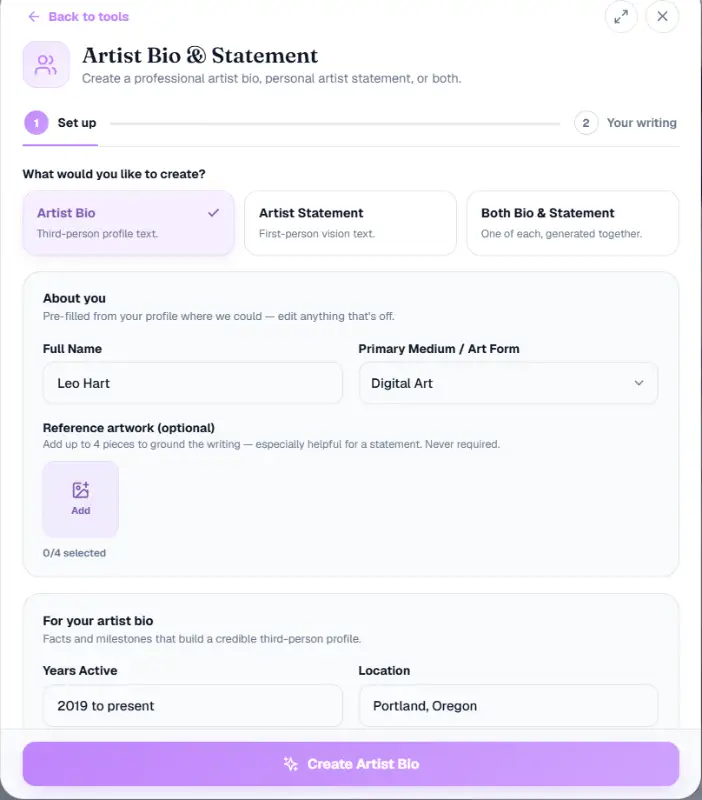
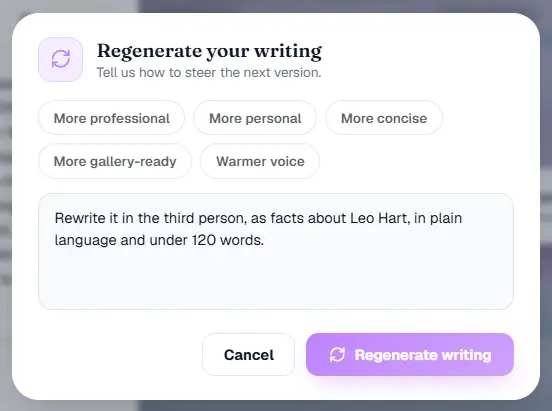
We tried it with a fictional digital artist, Leo Hart. The first draft had every fact we'd given it, but it came back in the first person and read more like a statement ("I've always been drawn to the quiet magic hidden within the everyday"). That's what Regenerate is for. It offers quick fixes (more professional, more personal, more concise, more gallery-ready, a warmer voice) or takes your own instruction. We asked for the third person, facts only, under 120 words.
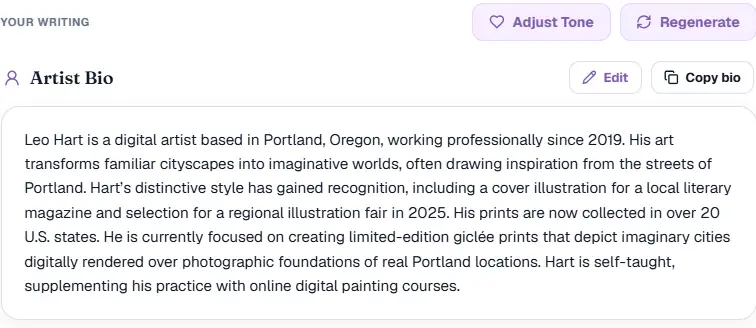
The second version was what a gallery wants: about 100 words, in the third person, opening with "Leo Hart is a digital artist based in Portland, Oregon" and working through the fair selection, the magazine cover and the 20 states. One thing to check before you send any bio anywhere: it chose "his" from the name alone. Make sure the pronouns are the ones you use, or ask for your name instead.
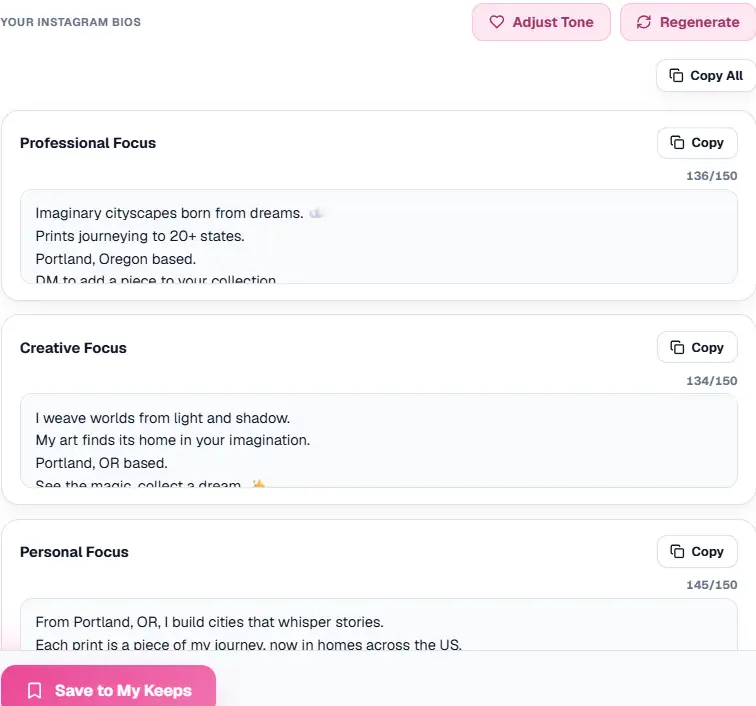
For the 150-character version, the separate Instagram Bio tool takes your art style, location and one achievement, and returns three options with a professional, creative and personal focus. The first one it wrote for Leo was "Imaginary cityscapes born from dreams. ☁️ Prints journeying to 20+ states. Portland, Oregon based. DM to add a piece to your collection." That's 136 characters, with room to spare. There's more on getting that one right in our Instagram bio guide. Both tools are included on every Brushly plan.
Keeping your bio current
A bio goes stale faster than any other document you own, because it's the one that lists your latest news. Keep a single master version with all your facts, and update it the week anything changes: a show opens, a prize is announced, you move city. Then paste the new version everywhere at once. Your online portfolio About page, your social profiles, and the application you send to the next open call, or to the Artist Spotlight, should never disagree about where you live or what you've done.
Quick answers
Should an artist bio be in first or third person?
Third person is the standard for bios, because galleries, publications and fairs reuse them word for word. Your artist statement is the piece written in the first person.
How long should an artist bio be?
Around 100 words covers most uses. Keep a 50-word version for listings and labels, and a longer one of up to 250 words for catalogues and grant applications.
What if I haven't had any exhibitions?
Lead with what you make and how, then use the evidence you do have: sales, commissions, markets, workshops, online following or a current project. The emerging artist example above has no shows at all.
Should I include my education?
Include it if it's relevant or notable, and say "self-taught" plainly if you are. Both are normal, and neither needs defending.
Get the bio written before the next "by tomorrow" email arrives. Every new Brushly account comes with a 7-day free trial, so open Brushly, put in your facts once, and keep short, long and Instagram versions ready to paste. See the plans for everything included.

