The open call looks perfect, and the list of what to send is short: ten images, a statement, and "CV (PDF, two pages maximum)". The only CV you have lists a café job, a retail job and a first-aid certificate.
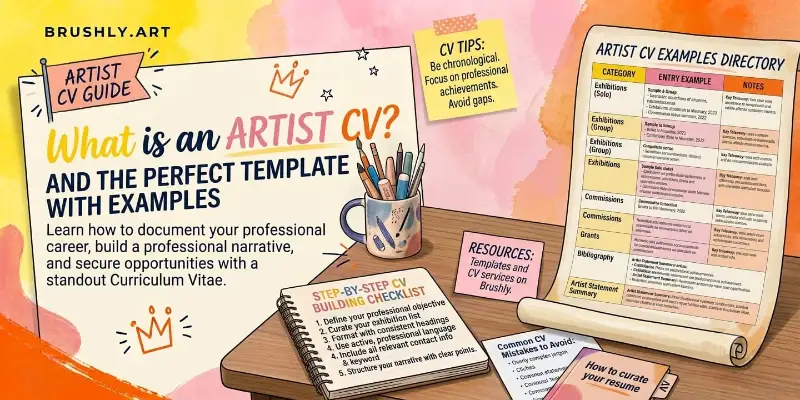
An artist CV is a list, not a story. It puts your name and contact details at the top, then records your art career in sections: education, solo exhibitions, group exhibitions, awards and residencies, collections, and press. Each entry is one line with the year, the title, the venue and the city, newest first, with no descriptions and no adjectives. Below are the sections in order with example lines, a complete example CV, the formatting rules galleries notice, and a quicker way to get the structure down.
Artist CV, resume or bio?
They get mixed up constantly, and applications often ask for all three.
| Document | What it is | Written as |
|---|---|---|
| Artist CV | A factual record of your art career | Short lines, grouped by section, newest first |
| Resume | Your employment history and skills, for jobs | Roles and responsibilities |
| Artist bio | A paragraph summarising who you are | Prose, usually third person |
A gallery reads your CV to answer one question fast: what have you done, where, and when? Anything that doesn't answer that belongs somewhere else.
The sections, in order
Use the sections you have and leave out the rest. An empty heading reads worse than a missing one.
| Section | What goes in it | Example line |
|---|---|---|
| Contact | Name, city, email, website | Maya Torres · Santa Fe, New Mexico · studio@example.com |
| Education | Degrees, significant courses and workshops | 2017 · Plein air painting intensive, a regional arts school |
| Solo exhibitions | Shows of your work alone | 2025 · Before the Day Starts, a Santa Fe gallery |
| Group exhibitions | Shows you were part of | 2024 · Small Works, a juried group show, Albuquerque |
| Awards, grants and residencies | Prizes, finalist places, funding, residencies | 2023 · Finalist, a regional landscape prize |
| Collections | Public, corporate or notable private collections | Private collections in the US and Canada |
| Press and publications | Articles, reviews, catalogues, interviews | 2024 · Feature, a regional arts magazine |
| Teaching and talks | Workshops you led, artist talks, panels | 2025 · Visiting artist talk, a community arts centre |
In a real CV, every venue and publication has its proper name. We've used descriptions here so the example can't be mistaken for anyone's real record.
A complete artist CV example
Here's how the sections come together for a fictional mid-career painter. Notice how little is said: that's the point.
Maya Torres Santa Fe, New Mexico · studio@example.com · mayatorres.example
Education 2017 · Plein air painting intensive, a regional arts school 2015 · Oil painting workshops, a community arts centre
Solo exhibitions 2025 · Before the Day Starts, a Santa Fe gallery 2022 · First Light, an Albuquerque art space
Group exhibitions 2024 · Small Works, a juried group show, Albuquerque 2023 · Desert Painters Now, a Taos gallery 2021 · Open studios, Santa Fe
Awards 2023 · Finalist, a regional landscape prize
Collections Private collections in the US and Canada
If you haven't exhibited yet
Every CV starts somewhere, and "no shows yet" isn't a reason to skip the document. List what you do have, honestly labelled: open studios, art markets and fairs, a café or library show, an online exhibition, a juried selection, workshops you've taught, commissions for organisations. Call the section "Exhibitions and events" if "Group exhibitions" feels like a stretch. What you mustn't do is dress a market stall up as a gallery show. People in the art world know the difference, and they talk to each other.
Formatting rules galleries notice
Newest first, within every section. A reader should see your most recent show without hunting for it.
One pattern for every line. Year, title in italics, venue, city, in the same order every time. Consistency is most of what makes a CV look professional.
Add "Selected" when it gets long. Once you have more than eight or ten entries in a section, call it "Selected solo exhibitions" and keep the strongest.
One to two pages. Unless an application asks for a full CV, cut to fit rather than shrinking the type.
No photo, no personal details. Your date of birth, marital status and a headshot don't belong on an artist CV.
Send a PDF with a clear name. "Maya-Torres-CV.pdf" is easier for a gallery to file than "CV final v3 (2).pdf".
Drafting yours with Brushly
The hardest part of a first CV is often the shape: which sections, in what order, with what wording. Brushly's Gallery Submission Package, one of the Palette tools, drafts a CV as part of a full application: an artist statement, a cover letter, the CV and an exhibition proposal, all from one set of answers.
It takes four short steps. You add your name, location, career stage, medium and style. Then you pick your education, roughly how many solo shows you've had, your awards, and the tone for your statement, plus an optional sentence on what your current work is about. Next come the gallery you're applying to and why you're a good fit. Last, you choose a CV format (clean minimalist, traditional academic, creative layout or gallery standard), the overall tone, and between one and six of your artworks to lead the submission.
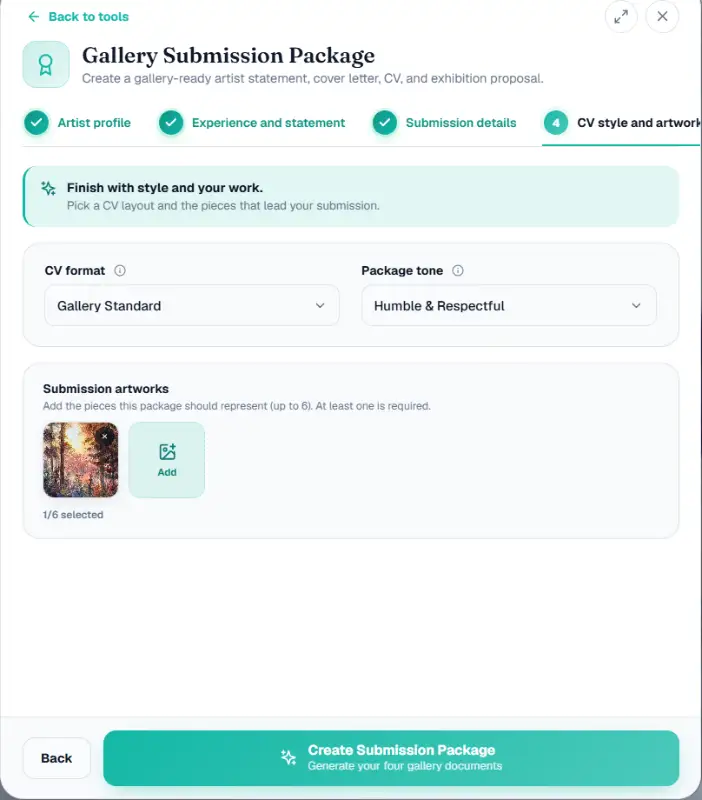
The CV arrives in its own tab, with every standard section in the order galleries expect: contact details, a short summary, education, solo and group exhibitions, awards, collections, press, professional experience and memberships. You can edit it in place, copy it, or download all four documents as one PDF with your logo at the top.
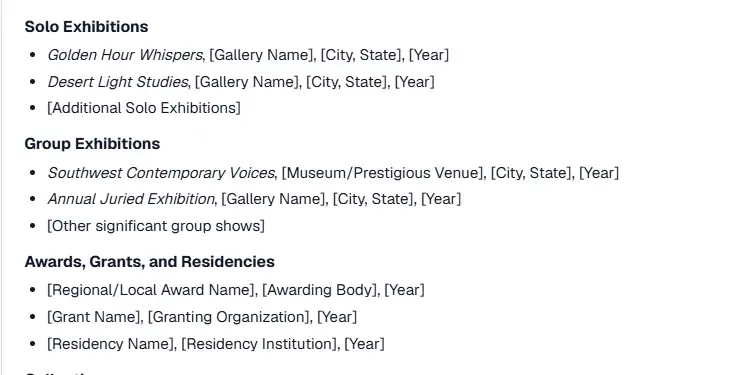
Now the important part. The form asks how many solo shows you've had, not which ones, so the tool can't know your real history. Where it has no facts, it leaves brackets such as "[Gallery Name], [City, State], [Year]" for you to fill in. But for our fictional painter, who we'd only described as having had two to four solo shows, it also made up plausible exhibition titles: "Golden Hour Whispers" and "Desert Light Studies", plus two group shows. None of them happened. Treat the draft as a layout, not a record. Replace every entry with a real show, date and venue, and delete anything you can't back up. A gallery can check a CV, and one invented line undoes the rest.
Used that way, it saves the fiddly part: the headings, the order and the consistent line format are done, and you only have to supply the facts. The package is included on Brushly's Professional plan and in the free trial.
Keeping your CV true and current
Keep one master CV with everything on it, and add a line the week something happens: the show opens, the prize is announced, the article comes out. Waiting a year means forgetting dates and venue names. Cut from the master for each application, instead of rebuilding from memory.
Put a current version where people can find it. A link from the About page of your online portfolio means a curator who likes your work can check your record in one click. And when you apply for things like the Artist Spotlight, you'll have the CV ready to attach.
Quick answers
How long should an artist CV be?
One to two pages for most applications. Emerging artists often fit on one page, and that's fine. Only send a longer, complete CV when it's asked for.
What's the difference between an artist CV and a resume?
A resume covers jobs and skills for employers. An artist CV records your art career, meaning exhibitions, awards, collections and press, as short dated lines.
Can I include online exhibitions?
Yes, if they were selected or curated. Label them clearly, for example "online exhibition", and list them with the same line pattern as everything else.
Should I list art fairs and markets?
Juried art fairs belong under exhibitions. Markets and open studios are worth listing early in your career, in an "Exhibitions and events" section, and can be dropped as your record grows.
Get the structure done tonight and fill in the facts tomorrow. Every new Brushly account comes with a 7-day free trial, so open Brushly, draft your full submission package, and send your next application with a CV that looks the part. See the plans for which tools each includes.

