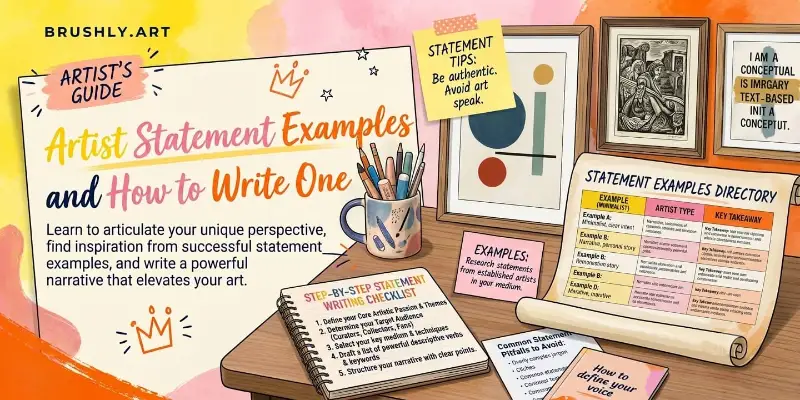
The open call closes on Friday. Everything is ready except one box: "Artist statement, 150 words maximum." You've been looking at it for twenty minutes.
A good artist statement is short, written in the first person, and says three things in plain words: what you make, how you make it, and why. That's it. Most statements go wrong by trying to sound like art criticism. As one artist put it on Reddit, they end up too long and trying to sound intellectual without being either. Below are six short examples across different mediums, a template you can fill in tonight, and the fixes that turn a vague draft into something a juror actually reads.
Six artist statement examples
Each of these is written for a fictional artist, and each runs under 120 words. The note after each one says what it's doing right.
Oil painter, landscapes
"I paint the hour after sunrise in small desert towns, when the light is low and nothing has happened yet. I work outdoors in short sessions, forty minutes at most, because the light changes faster than I can think. Then I finish each painting in the studio over several days, in thin glazes that let the ground glow through. I'm not interested in the grand view. I'm interested in a wall, a fence, a patch of road, and how ordinary they look when the day hasn't started asking anything of them."
Why it works: it names a time, a place, a method and a point of view, and not one sentence needs a dictionary.
Ceramicist, functional ware
"I make bowls and cups meant to be used every day, not kept on a shelf. I throw on the wheel and fire in a wood kiln, which leaves ash marks I can't fully control. I like that. Each piece carries a record of where it sat in the fire. I want the objects in your kitchen to have a history, even a small one, and to feel slightly different in your hand from the one next to it."
Why it works: it turns a technical detail, wood firing, into the reason the work exists.
Digital illustrator
"I draw imaginary cities built on top of real ones. I start from photographs of streets in my neighbourhood and redraw them digitally, adding towers, bridges and rooftop gardens that don't exist but feel like they could. The work comes out of a simple question I keep asking on my walk to the bus: what would this place look like if it had been designed by someone who loved it?"
Why it works: one clear idea, one concrete process, and a question the viewer can carry away with them.
Textile artist
"I weave with fabric from clothes people have given me: shirts, dresses, a grandmother's apron. I cut them into strips and weave them on a floor loom into wall pieces, keeping the colours in the order the stories were told to me. Every piece is a portrait of a person I never paint. The work is about what we keep, what we pass on, and how much a piece of cloth can hold."
Why it works: the material is the meaning, and it says so in one sentence.
Photographer, portraits
"I photograph people in the rooms where they spend the most time, and I ask them not to tidy first. A kitchen table covered in homework says more than a clean one. I shoot on film with a single available light, usually a window, and I print everything myself. I'm trying to make portraits that look the way a person feels to the people who love them, not the way they look in a profile picture."
Why it works: it's specific about method, and the last line gives the work a purpose without inflating it.
Abstract painter, mixed media
"My paintings start with marks I make without planning, pencil, charcoal, a dragged brush, and then I spend weeks deciding which ones to keep. Most get buried under layers of paint and scraped back, so the finished surface is full of half-visible decisions. I think of abstraction as a way of slowing down. I hope a viewer stays long enough to find the marks underneath, the way you notice more of a room the longer you sit in it."
Why it works: abstract work gets the hardest time from statements, and this one simply explains the process and trusts it.
A fill-in-the-blank artist statement template
If you're starting from nothing, fill in these five sentences, then rewrite them in your own voice.
I make [what: medium, subject, format].
I work by [how: process, materials, the step that matters most].
I'm interested in [the idea or feeling you keep returning to].
[One concrete detail: a place, an object, a moment] is where it started or keeps coming back.
I hope people who see the work [what you'd like them to notice, feel or do].
Five sentences is roughly 80 to 100 words, which is the right length for most websites and applications.
How to write an artist statement people actually read
Here's a typical first draft, and the same statement after a pass through the rules below.
Before: "My work explores the interconnectedness of memory and identity through the transformative power of colour, interrogating the liminal spaces between presence and absence."
After: "I paint the houses I grew up in from memory, then compare them with photographs. The gaps between the two, the wrong colour of a door or a window that was never there, are what the paintings are about."
The second version is longer, but it takes less effort to read, because every word points at something real. The rules that got it there:
Start with what you make. Your first sentence should tell a stranger what kind of artist you are, painter, potter or photographer, and what you point that at.
Name the material and the method. "Oil on linen, in thin glazes" is more interesting than "painting" to anyone deciding whether to look closer.
Cut words you'd never say out loud. "Explores", "interrogates", "juxtaposes" and "liminal" are fine if you truly mean them. Usually they're filling a gap where a real idea should be.
One idea is enough. A statement isn't a manifesto. It's the one sentence you'd want someone to remember.
Read it out loud. If you'd feel silly saying it to a visitor at your stand, rewrite it until you wouldn't.
Keep versions. A 50-word version for fair labels and your Instagram bio, a 100 to 150-word version for your website, and a longer one for applications that ask for it.
Artist statement vs artist bio
They're easy to confuse and often asked for together. A statement is first person and about the work: what you make and why. A bio is usually third person and about you: where you're based, your training, your shows and awards, written as facts. A gallery might use your bio in a press release and your statement on the wall.
Getting a first draft from your own answers
If the blank page is the problem, Brushly's Artist Bio & Statement tool, one of the Palette tools, starts you from questions instead. You choose a bio, a statement, or both. The form fills in what it already knows from your profile, then asks the things the template above asks: your medium, your artistic vision, your themes, your process, what inspires you, and the effect you hope the work has. For the bio, it asks for years active, location, current focus and achievements. You can add up to four of your artworks as reference, which helps a statement stay grounded in the actual work.
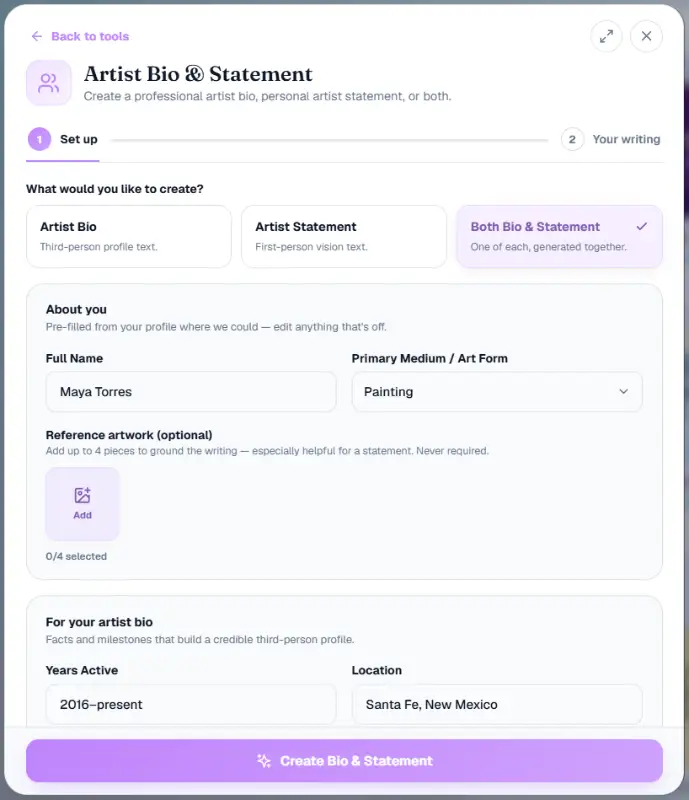
It writes both pieces in a few seconds, each with Edit and Copy buttons, and you can ask for another version that's more concise, more gallery-ready, more personal, or in a warmer voice.
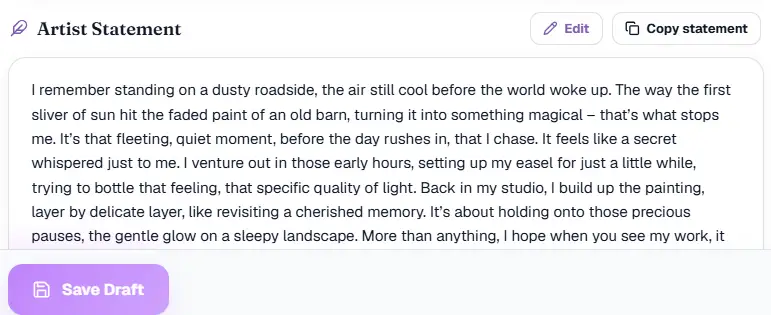
Treat what comes back as a first draft, not a finished statement. For our test artist, a landscape painter, the draft had the right facts and the right idea, but it leaned poetic in places ("It feels like a secret whispered just to me"). One pass with the rules above, cutting the lines you wouldn't say out loud and naming the process plainly, gets it most of the way. That's still far faster than starting from a blank box on Friday night. Your finished statement then belongs on your online portfolio, where collectors will actually read it.
Quick answers
How long should an artist statement be?
For most websites and applications, 100 to 150 words. Keep a 50-word version for fair labels and social profiles. If an application gives a word limit, treat it as a ceiling, not a target.
Should an artist statement be written in first person?
Yes. A statement is you talking about your work, so "I" is normal and reads as more direct. Your bio is the piece that's usually written in third person.
How often should I update my artist statement?
Whenever your work changes direction, and at least once a year. A statement written for work you made three years ago is a common reason applications feel off.
Where do I use an artist statement?
On your website or portfolio, in gallery and open call applications, on exhibition walls, and in shortened form in your Instagram bio. If you'd like your work featured, the Artist Spotlight submission asks for it too.
Get the first draft out of your head tonight. Every new Brushly account comes with a 7-day free trial, so open Brushly, answer the questions once, and start editing a statement instead of staring at an empty box.

