
You spot it on Instagram three days before the deadline: a juried show, a theme that fits your new series, a $35 entry fee. Then you open the form. It wants five images at a specific size, an image list, a 200-word statement, a CV and answers to three questions you've never thought about. By the time you've found it all, the deadline has passed.
A call for artists, also called an open call or call for entry, is an invitation to submit work for a specific opportunity: a juried exhibition, a solo show, a public art commission, a residency, a grant or a prize. You read the call's details, check you're eligible, prepare the materials it asks for, and submit on the organiser's own site before the deadline. Below: the main types of open call, where they're listed, how to tell a good one from a bad one before you pay, the kit to keep ready, and a faster way to prepare each entry.
The main types of open call
| Type | What you get | What they usually ask for |
|---|---|---|
| Juried group exhibition | A place in a show, sometimes prizes | Images, image list, entry fee |
| Solo exhibition proposal | A show of your own work | Images, statement, CV, proposal |
| Public art or commission | A paid commission for a site | Qualifications, past projects, sometimes a concept |
| Residency | Time, space, sometimes a stipend or lodging | Statement, CV, project plan, references |
| Grant or prize | Money, sometimes a show | Images, statement, how you'll use the funds |
| Online exhibition | A place in a curated online show | Images, short bio, entry fee |
| Art fair or festival | A stand or booth | Images, booth fee, sometimes a jury fee |
The type matters, because it changes what the jury is judging. A juried show is mostly about the images and the theme. A residency or grant cares just as much about your plan and your track record.
Where calls for artists are listed
No single list has everything, so most artists check a few sources regularly.
State and local arts agencies. Many publish an opportunities page. The California Arts Council and the Texas Commission on the Arts both do, and the Massachusetts Cultural Council publishes a weekly roundup of calls, residencies and contests.
Call-for-entry platforms. Many juried shows and public art programmes take applications through dedicated systems, CaFÉ (CallForEntry.org) being one of the best known in the US. Browsing a platform's open calls shows you everything using it.
National opportunity boards. NYFA's opportunities board lists open calls, residencies and more across the US and internationally.
Venues themselves. University galleries, art centres and city public art programmes often post calls only on their own sites. If there's a venue you'd love to show in, check its website every season.
Social media and newsletters. Accounts and newsletters that round up calls are useful, but they repost. Always go to the organiser's own page before you pay anything.
How to judge a call before you pay
An entry fee is normal for juried shows, but not every call deserves your money. Check these before you start.
Who runs it. A real venue with a history of past shows you can look up. If you can't find where the exhibition will actually hang, walk away.
What the fee buys. Is it per piece or per entry? "$25 for up to three pieces" is very different from $25 each. Also look for extra charges if you're accepted, such as hanging, catalogue or "participation" fees.
What you could win or earn. Cash prizes, a solo show, sales. If work is for sale, check the commission. Many venues keep a share, and the call should say how much you keep.
Who's judging. A named juror or panel is a good sign. You can look at their past selections to see whether your work fits.
The rights clause. Allowing the organiser to use images of your work to promote the show is standard. Giving them broader rights to reproduce or sell your images is not.
Dates beyond the deadline. When do they notify you, when must work arrive, who pays shipping both ways, and is the work insured while it's there?
Red flags: calls where everyone who pays is accepted, "exhibitions" with no named venue, fees that grow after acceptance, and pressure to decide quickly.
The kit to keep ready
The artists who enter a lot of calls aren't faster writers. They have the materials ready before the call appears.
Images: well-lit, square-on photos of each piece, cropped to the edges, saved at a high resolution you can resize to whatever a call asks for.
An image list: title, year, medium, dimensions and price for every piece, in one document.
An artist statement: a 100 to 150-word version, and a shorter one for tight word limits.
A CV: exhibitions, awards, education and collections, newest first, one to two pages.
A short bio: 50 and 100-word versions, in the third person.
A few answers you can adapt: why this work, why this venue or theme, and how you'd use a prize or residency.
With these ready, most calls take an hour to enter instead of an evening.
Keeping track of deadlines
Enter regularly rather than in bursts. A simple list with the call, the organiser, the deadline, the fee, what you sent and the result is enough, and it becomes a record of what worked. Expect more rejections than acceptances. Jurors are choosing for one show and one theme, and a no usually means "not for this", not "not good enough". The pieces that get turned down this month often suit the next call perfectly.
Finding and preparing open calls in Brushly
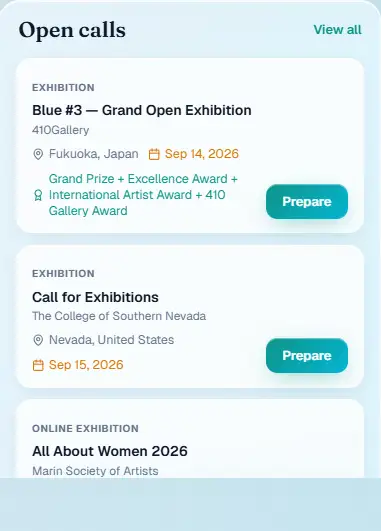
Brushly puts open calls on your home screen. The "Open calls" card shows the calls closing soonest, with a button to start preparing each one.
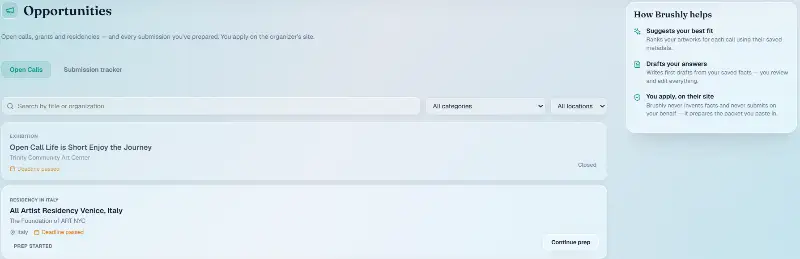
"View all" opens the full Opportunities list: exhibitions, residencies, grants and prizes, online exhibitions, competitions and public art commissions. You can search by title or organisation, filter by category and by online or in-person, and the list is sorted by deadline. It's a curated list rather than a giant database. When we looked, it had 21 calls, 12 of them still open, alongside a Submission tracker tab for everything you've started.
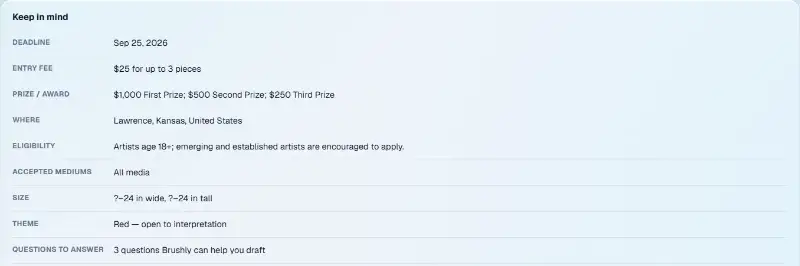
Choose one and the Details step pulls the facts you'd otherwise dig out of a long prospectus: the deadline, entry fee, prizes, location, eligibility, accepted mediums, size limits, the theme, how many questions you'll need to answer, and where to apply. For one juried exhibition we checked, that was $25 for up to three pieces, three cash prizes, a 24-inch size limit and three questions, all on one screen.
From there, four more steps turn the call into a finished entry. A profile check shows which of your saved facts it can use, and what's missing. Missing facts are flagged for you to fill in, never guessed. Artwork fit suggests which of your pieces suit the call, using their saved details such as medium and size, and labels each a strong fit, a possible fit or one to review. You can ignore every suggestion and pick anything you own. Draft answers writes first drafts of the organiser's own questions from your facts, shows which facts it used, and lets you regenerate any answer. It never ticks a consent box for you.
The last step is a submission packet: your chosen artworks and every answer, ready to copy, plus a link to the organiser's site. Brushly doesn't submit anything on your behalf. You paste the packet into the official application, then mark it submitted so your tracker stays up to date.
If a call also wants a polished statement, CV and cover letter, the Gallery Submission Package in the Palette tools drafts all of them from one set of answers. And the facts the drafts rely on come from your online portfolio, so keeping that current pays off every time you apply.
One more call worth knowing
Separate from the open calls above, Brushly runs its own Artist Spotlight, an open call to be featured on the Brushly platform. You apply on that page with a short application, and it's a simple way to get your work in front of a new audience while you wait to hear back from the others.
Quick answers
What's the difference between a call for artists and an open call?
Nothing, in practice. "Call for artists", "open call", "call for entry" and "call to artists" all mean an invitation to submit work for an opportunity. Public art programmes sometimes use RFQ (request for qualifications) or RFP (request for proposals) for more formal versions.
Are entry fees normal?
For juried exhibitions, yes, and they usually cover jurying and administration. Residencies and grants are more often free to apply for. Be wary of fees that appear only after you're accepted.
How many pieces should I submit?
As many as the call allows, but only if every piece is strong and fits the theme. Three excellent, consistent works beat five uneven ones.
Do I need gallery representation or a degree to apply?
Rarely. Check the eligibility section. Many calls are open to any artist over 18, and plenty specifically welcome emerging artists.
Stop finding great calls three days too late. Every new Brushly account comes with a 7-day free trial, so open Brushly, check the open calls on your home screen, and prepare your next entry with the facts already in place. See the plans for everything included.

