
Someone has just agreed to pay $900 for one of your paintings. Then the question arrives: "Does it come with a certificate of authenticity?"
A certificate of authenticity for art is a short, signed document that says who made the work, what it is, and when it left your studio. At minimum it carries your name, the title, the year, the medium and size, a unique number and your signature. What separates a certificate that means something from one that doesn't is whether a buyer, or the buyer after them, can check it.
So here's what to put on one, whether you need one at all, and how to issue a certificate that can be verified in a few seconds.
Do you actually need a certificate of authenticity?
Ask this on Reddit and the top answer is blunt: sign the painting, give the buyer a receipt, and you're done. For a lot of small sales that's fair. A signature and a receipt prove that you sold a painting to someone.
What they don't do is travel. The receipt stays in your first buyer's drawer, and the painting doesn't. When the work is resold, gifted, or passed down to someone's children, the new owner has a signature they can't check and no paperwork at all. A certificate is the document that goes with the work, so each owner can hand it on to the next.
It matters most in four situations:
Originals priced above a few hundred dollars, where the buyer is making a real decision.
Limited edition prints, where the edition number is most of the value.
Work sold online to people who have never met you.
Anything likely to be resold, which includes most work by an artist whose prices are rising.
For a $40 sketch at a market stall, the receipt is plenty. For the $900 painting, give the certificate.
What to put on a certificate of authenticity
A good certificate answers every question a future owner, gallery or appraiser might have about the work, without them needing to find you first.
| Field | Why it's there |
|---|---|
| Artist name | The claim the whole document exists to support |
| Artwork title | Ties the certificate to one specific piece |
| Year created | Places the work within your practice |
| Medium and materials | "Acrylic on stretched canvas," not just "painting" |
| Dimensions | Height by width, plus depth for sculpture, with units |
| Edition number | For prints, such as "7 of 25". Leave it off originals |
| Image of the artwork | So the certificate can't be moved to a different piece |
| Date of issue | Usually the date of sale |
| Unique certificate number | Lets anyone look the certificate up later |
| Your signature | Handwritten, or a clean digital version |
| Your contact details | An email or website, so the work traces back to you |
| Collector's name | Records who owned the work first |
| Copyright line | States that you keep copyright and reproduction rights. Buying a painting doesn't transfer them, and many buyers don't know that |
| Verification link or QR code | Where someone confirms the certificate is genuine |
Two things are worth leaving off. The price dates badly and is nobody's business once the work is resold. And anything you can't stand behind, like an estimate of value, belongs to an appraiser, not to you.
Many artists add one sentence of certification above the signature. Something like this works:
"I certify that this is an original work of art created by me, and that the details on this certificate are accurate."
A certificate is a statement from you, the artist. It isn't a contract, and nothing here is legal advice. If you sell at prices where the wording really matters, have a lawyer read it.
Why a template certificate proves less than it looks
Search for a certificate of authenticity template and you'll find plenty: free fillable PDFs, Canva layouts, even packs of blank certificates with gold foil borders. They all look official, and that's the problem. Anyone can fill in the same template, so a certificate that exists only on paper proves only that somebody printed it.
The certificate number is where it falls apart. A number on a card is decoration unless it's recorded somewhere a buyer can look it up. Without that record, a collector buying your painting secondhand can't tell your certificate from a convincing copy, and neither can the gallery they might later sell it through.
The useful question, then, isn't which design to use. It's where the certificate lives when someone wants to check it.
A certificate of authenticity any buyer can verify
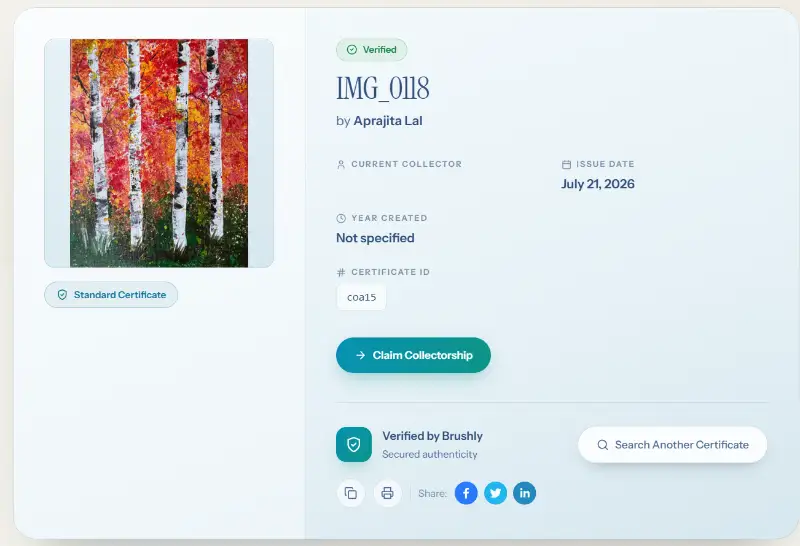
Brushly's certificates are built around that record. Every certificate you issue gets its own serial number and a QR code printed on it. Anyone who scans the code, or types the number in at brushly.art/verify, lands on a page that shows the artwork, your name, the issue date and the certificate ID, marked as verified.
Making one takes a few minutes. You pick the piece from your Brushly studio, choose the type of certificate, and the editor lays your details onto a template. Your name, the artwork's title and the date fill in from what Brushly already knows. You add the collector's name, which is what appears on the verify page, and you can give the certificate your own number, like COA-2026-014, alongside the serial Brushly creates. The verify page finds a certificate by either one. The template has places for everything in the table above: title, medium, dimensions, year, signature, contact email, the artwork's image and the QR code. Click any element and drag it where you want it. Change the fonts, sizes and colors field by field, then save the layout as your own template so the next certificate matches.
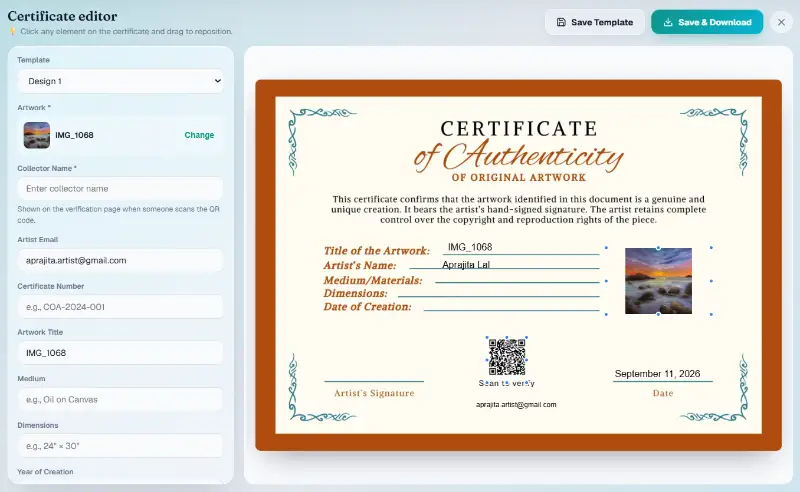
When it looks right, you download it as a PDF. That's the moment the real serial number is created and the record goes live, so the certificate in your buyer's hands and the one on the verify page are the same thing.
Because every certificate starts from the artwork's record, it sits beside everything else you know about that piece. The same record lives in your inventory, and when the painting sells, the buyer's invoice comes from the same place.
What happens when the painting changes hands
A certificate earns its keep on the second sale, not the first. Brushly records the current collector on the certificate, and the verify page keeps a transfer history. A painting that has passed through three owners shows all three.
There are two types of certificate, and the difference is who's allowed to change the owner.
With a Standard certificate, anyone holding the serial number can record themselves as the new collector from the verify page. It's the low-friction choice, and it suits most work.
With a Royalty certificate, the new owner has to ask. They send a transfer request from the verify page, it arrives in your Transfer requests inbox, and nothing changes until you approve it. If you want to know every time one of your pieces is resold, that's the type to use.
Small details that make a certificate hold up
Write the certificate number on the back of the work too, in pencil or on a label. If the paper certificate goes missing, the number on the stretcher bar still leads to the online record.
Issue one certificate per work, and never a second for the same piece. Two certificates for one painting is exactly what a careful buyer looks for.
For prints, put the edition number on both the print and the certificate, and check that they match.
Keep your signature consistent. The one on the certificate should look like the one on the work.
And hand it over with the painting. A certificate emailed separately gets lost in an inbox; one packed with the work stays with it.
Quick answers about certificates of authenticity
Is a certificate of authenticity legally binding?
It's your signed statement that the work is genuine and the details are accurate. It isn't a contract, and it says nothing about what the work is worth. For high-value sales, a lawyer can review your wording.
Can I make a certificate of authenticity for my own art?
Yes. For a living artist, you're the right person to issue it. Galleries sometimes add their own certificate for work they sell, alongside yours.
Do prints need a certificate of authenticity?
Limited edition prints do, because the edition number and size are what make the print collectible. Open edition prints usually don't.
What happens if the certificate is lost?
If it was issued with a verification record, nothing important is lost. The owner can look the certificate up by its number, and you can find it from your own list of issued certificates.
If you're about to sell something that deserves a certificate, make it one that can be checked. Every new Brushly account comes with a 7-day free trial, so open Brushly, pick the piece you're selling, and issue its certificate before it leaves the studio.

