You finally work up the nerve, wrap three paintings in blankets, and carry them into the gallery you've admired for years. The person at the desk is kind about it. "We don't review work in person," she says, and points you to a line on the website you'd never noticed: "We are not currently accepting unsolicited submissions."
Galleries take on artists whose work fits their programme, whose prices suit their collectors, and who are easy to work with. Most artists get in through research, relationships and a gallery's own submission process, not through a walk-in. The route that works is to build a consistent body of work, find the galleries that already show work like yours, follow their guidelines exactly, send a short, tailored approach, and understand the consignment terms before you sign. Here's each step, what to send, and how to keep track of your work once it's on their walls.
Check you're ready first
A gallery is taking a commercial risk on you, so it looks for signs that the risk is small.
A consistent body of work. Fifteen to twenty recent pieces that clearly belong together in subject, medium or approach. A gallery wants to know what it would be selling next year, not just this month.
Prices you can explain. A consistent pricing method by size, and a record of what has sold. Prices that jump around worry galleries more than prices that are modest.
A place to see it all. An up-to-date online portfolio with good images, titles, sizes and prices.
The documents. An artist statement, a short bio and a CV, ready to send in any length.
If you're not there yet, open calls, juried shows, art fairs and group exhibitions are how you build the record that makes a gallery say yes later.
Find the galleries that fit your work
The most common mistake is approaching galleries at random. Research narrows the list to the few where you genuinely fit.
Look at who they already show. A gallery's artist list is its programme. If none of its artists work anywhere near your style, medium or scale, your work won't fit however good it is.
Check their prices. If a gallery's typical piece sells for ten times yours, or a tenth, the collectors who walk in won't be yours.
Go in person. Visit exhibitions and openings. Buy a catalogue, sign the mailing list, and talk to the staff about the work on the walls, not yours. Relationships start long before you send anything.
Know the types. Commercial galleries sell work and take a commission. Co-operative galleries are run by their member artists, who usually pay dues and share the running of the space. Non-profit spaces and university galleries programme exhibitions rather than represent artists. Be wary of "vanity" galleries that charge artists to hang work and make their money from those fees rather than from sales.
Aim for a shortlist of five to ten galleries where the fit is obvious, and write down why each one fits. You'll need that sentence later.
How galleries actually find artists
Many galleries find new artists through people and places they already trust: recommendations from the artists they represent, curators and collectors, art fairs, juried exhibitions, open studios and, increasingly, Instagram. A smaller number review submissions, usually at set times or through a form on their website.
That shapes your approach. Follow each gallery's submission guidelines to the letter where they exist. Where a gallery says it isn't accepting submissions, don't send one anyway. Build the relationship instead, by going to openings, entering the shows its curators jury, and letting your work be seen where the gallery is looking.
What to send
When a gallery does invite submissions, keep the package short and easy to open.
| What | Why it matters |
|---|---|
| A short email | It's often the only thing read in full |
| A link to your portfolio | The fastest way to see the whole body of work |
| 10 to 15 images, or a single PDF | Enough to show consistency, not so many it's a chore |
| An image list | Title, year, medium, size and price for each piece |
| Artist statement and CV | Context and track record, attached or linked |
Send exactly what the guidelines ask for, in the format they ask for. A gallery that asks for a PDF under 5 MB and receives 40 attachments learns something about you before looking at the work.
Writing the email
Three short paragraphs are enough. Say who you are and what you make. Say why this gallery, with the specific reason you wrote down during your research. Then point to the work and offer more. Here's an example for a fictional painter:
"Dear [name], I'm a painter based in Santa Fe, making small oil paintings of desert towns in the first hour after sunrise. I've followed the gallery's landscape programme since your exhibition of [artist] last spring, and I think this series would sit naturally alongside it. You can see the full body of work, with prices, at [portfolio link], and I've attached a short PDF of ten recent pieces with my statement and CV. Thank you for your time. Maya Torres"
If you hear nothing, one polite follow-up after four to six weeks is fine. After that, let it go and keep building your record.
Drafting the package with Brushly
If the writing is what stops you, Brushly's Gallery Submission Package, one of the Palette tools, drafts the whole set from one set of answers: an artist statement, a cover letter, a CV and an exhibition proposal. You name the gallery you're approaching and describe your relationship with it (a first-time submission, a referral, or someone who knows its programme), choose what most sets your work apart, and pick up to six of your artworks to lead the submission.
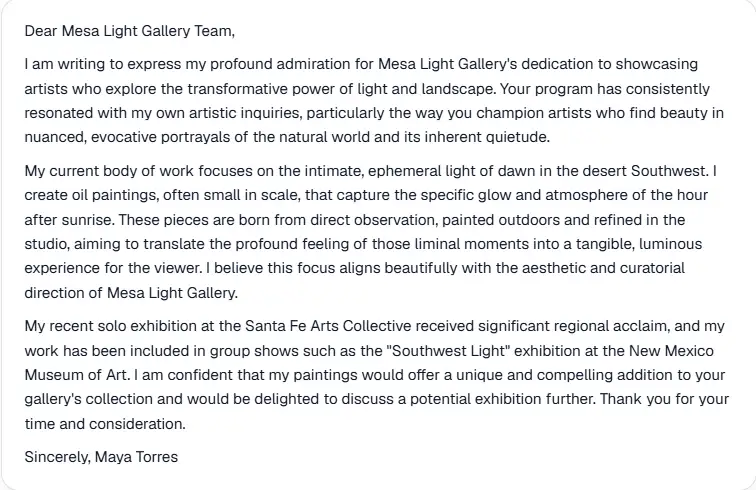
The cover letter is addressed to the gallery by name and ties your work to its programme. For our fictional painter, it described the dawn paintings and the outdoor-then-studio process accurately. Then it did something you must watch for. It claimed "a recent solo exhibition at the Santa Fe Arts Collective" and a group show "at the New Mexico Museum of Art". We never gave it either. We'd only said the artist had had two to four solo shows. One of those is a real museum.
A gallery will check claims like that, and one false line can close the door for good. So read every sentence of the draft and delete anything you didn't tell it. Replace vague credentials with your real ones or leave them out, and cut the letter down to the three short paragraphs above. It also leaned flowery ("profound admiration", "liminal moments"), and a first approach reads better plain.
The exhibition proposal is where the draft earns its place. When a gallery is interested, the next question is often "what would a show look like?", and the proposal gives you a starting answer. Ours suggested a title, roughly fifteen to twenty small and medium paintings, a hanging idea with the small works grouped together, and practical offers: framed, ready-to-install work, wall text and attendance at the opening.
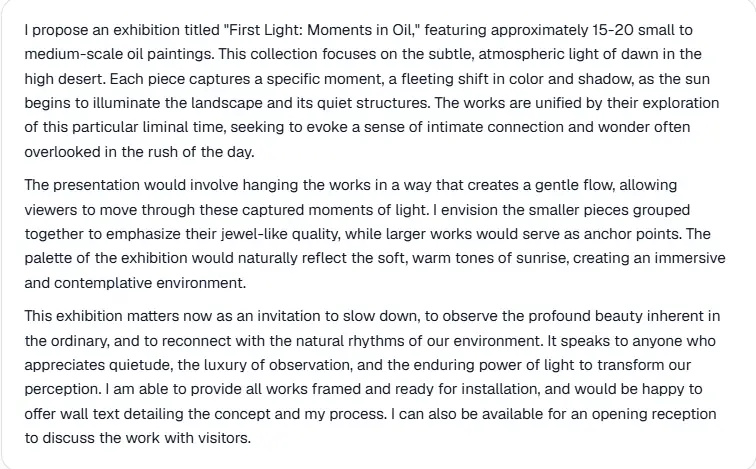
Everything can be edited in place, copied, or downloaded as a single PDF. The package is included on Brushly's Professional plan and in the free trial.
Before you sign: the consignment terms
Most galleries sell work on consignment. You still own each piece until it sells, and the gallery takes a commission on the sale. Before any work leaves your studio, get these in writing:
The commission, as a percentage of the sale price. It's often substantial, so know the number.
Who sets the price, and whether the gallery can discount without asking you.
When you're paid after a sale, for example within 30 days.
Insurance while the work is at the gallery and in transit.
Costs: who pays for framing, shipping, photography and promotion.
Exclusivity: whether you can sell the same work, or any work, elsewhere in the area.
Duration and returns: how long the agreement lasts and how unsold work comes back.
A consignment list, signed by both of you, recording every piece, its price and its condition.
Keeping track once you're in
The moment work goes to a gallery, you need to know exactly what is where. In Brushly's inventory, add the gallery as a location and move each consigned piece to it. You can filter to that location and export a CSV to send the gallery as your list, and the inventory report breaks your stock down by location. When a piece sells, mark it sold and issue a certificate of authenticity with its own serial and QR code, so the new owner can verify it at any time.
Quick answers
Should I pay a gallery to show my work?
Be very careful. Reputable commercial galleries earn their money from commission on sales, not from fees charged to artists. Co-operative galleries, where members share costs and running the space, are a different, open arrangement.
Do galleries accept unsolicited submissions?
Some do, usually through a form or at set times, and they say so on their website. Many don't. Respect whichever it is, and build a relationship where submissions are closed.
How many pieces should I send in a first approach?
Ten to fifteen images of recent, consistent work, or whatever the guidelines specify. Choose quality and coherence over quantity.
What if they say no?
Most artists hear no far more often than yes, and the reason is usually fit or timing. Ask whether you may stay in touch, keep going to their openings, and approach again when you have a new body of work.
Get your gallery package drafted, then make it true to you. Every new Brushly account comes with a 7-day free trial, so open Brushly, draft your statement, cover letter, CV and proposal, and go into your next approach prepared. See the plans for which tools each includes.

