
The message arrives at 10pm: "Hi! How much would you charge to paint my dog?" There's no painting yet, no photo of the dog, and you have no idea how long it will take. You want the job, and you don't want to guess.
Price a commission the way you'd price any original: materials, plus your hours at a fair rate, plus a margin. Then add what's specific to commissions: the time you spend with the client, the revisions, the risk that they disappear halfway, and the cost of a deadline. Put the result on a commission price sheet so you're not reinventing the number in every DM. Here's how to work it out, what the price sheet should say, and how to send a professional reply in minutes.
Start from the same floor as any painting
Before anything commission-specific, work out what the piece costs you to make.
Take a 16 × 20 inch acrylic pet portrait. Say materials come to $55, and the painting itself takes about 16 hours. Now add the hours nobody counts: the first messages, the reference photos, a sketch for approval, and a round of changes. Call it 3 hours. At $25 an hour, 19 hours comes to $475. Add the $55 of materials and you're at $530.
That's a floor, not a price. Add a margin for your studio, tools and the commissions that fall through, say 20%, and $530 becomes $636. Round it to a number you'd happily say out loud: $650.
What makes commissions different
Four things make a commission cost more to produce than the same painting made on spec.
Client time is real time. Emails, calls, mood boards, sketches and progress photos can add hours to a small piece. If they aren't in the price, you're doing them for free.
Revisions have a cost. A small colour change is quick. Repainting a face is a new painting. Without a written limit, "just one more tweak" can go on for weeks.
The client can vanish. You buy materials and block out time on the strength of a yes. A deposit is what stops a cancelled commission costing you money.
Deadlines cost extra. A client who needs it for a birthday in ten days is asking you to move everything else. That deserves a rush fee, not a favour.
Build a commission price sheet
A price sheet does the pricing once, so every inquiry gets the same, confident answer. Here's an example for one artist's pet portraits, built from the hourly maths above. Your numbers will differ with your speed and experience.
| Size | Starting price, one subject | Each additional subject |
|---|---|---|
| Small, 8 × 10 in | $250 | $80 |
| Medium, 11 × 14 in | $400 | $120 |
| Large, 16 × 20 in | $650 | $180 |
| Extra large, 18 × 24 in | $850 | $220 |
Underneath the prices, write your terms. Taken together, these are your commission terms of service.
Deposit: 50% to book the slot, with the balance due on approval of the finished piece. On the $650 portrait, that's $325 up front.
Revisions: two rounds of minor changes included; bigger changes quoted separately.
Timeline: standard turnaround of three to four weeks from the deposit.
Rush orders: 50% extra for one to two weeks, so the $650 portrait becomes $975.
Flexible deadlines: a discount for clients happy to wait five to six weeks, such as 10% off, which brings it to $585.
Payment methods: bank transfer and card, or whatever you actually accept.
Shipping: quoted separately, and not included in the turnaround.
Terms like these aren't a contract, and nothing here is legal advice. But written down and agreed before you start, they settle almost every argument before it happens.
Deposits, revisions and rush fees in practice
Ask for the deposit before you buy materials or clear time in your diary, and say plainly whether it's refundable. Many artists make it non-refundable once work has started, because by then the cost has been spent.
Count revisions from the sketch, not the finished painting. Changes are cheap on a sketch and expensive on a canvas, so get the client's sign-off at the stage where saying no is easy.
Quote the rush fee as a clear percentage on your price sheet rather than inventing it under pressure. A client who sees "+50% for under two weeks" before they ask rarely argues with it.
Sending the reply and the rate sheet with Brushly
Once the numbers are settled, the slow part is writing it all down nicely for each new client. Brushly's Commission Response & Rate Sheet tool, one of the Palette tools, drafts both.
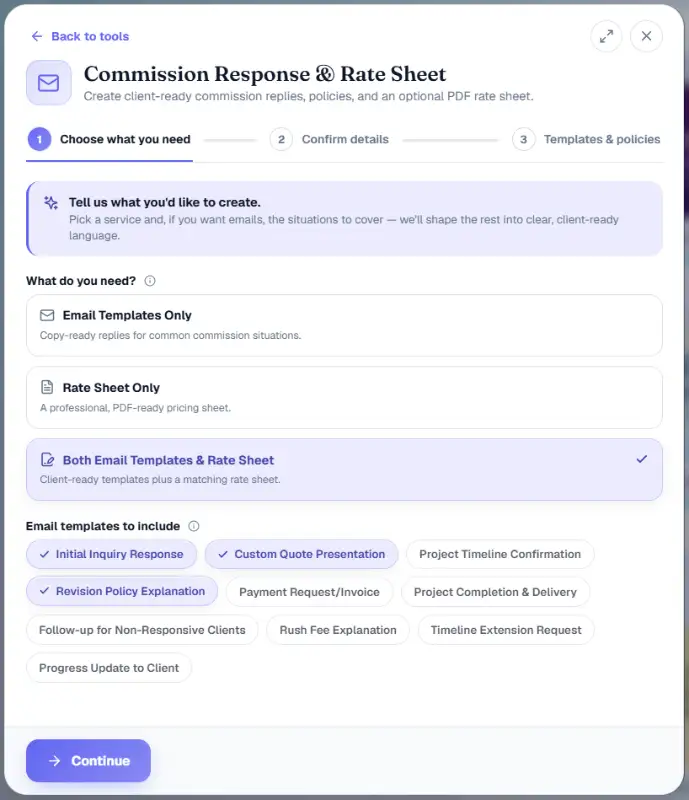
You start by choosing email templates, a rate sheet, or both, and ticking the situations you want replies for. There are ten of them, from the first inquiry and the custom quote to revision policies, payment requests, rush fees and chasing a client who's gone quiet.
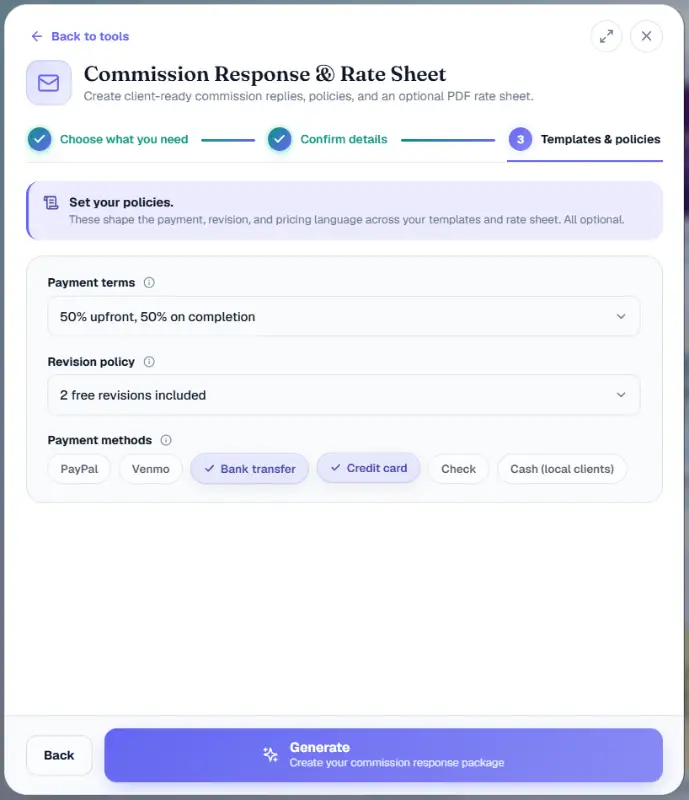
Then you confirm the commission details: your name, the type of work, and optionally the medium, size, starting price and timeline. The timeline choices carry pricing conventions with them. Rush, one to two weeks, is marked +50%, and an extended five-to-six-week deadline is marked −10%. Finally you set your policies: the payment terms, the revision policy and how clients can pay.
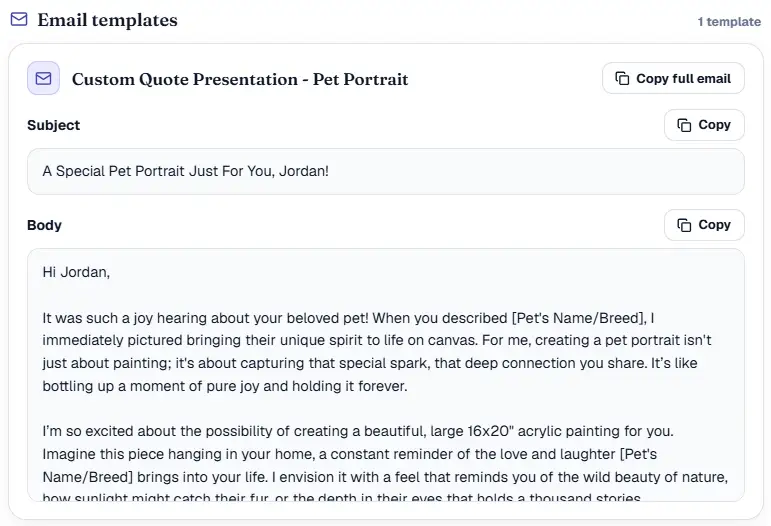
What comes back is ready to edit and send. For our test commission, a 16 × 20 inch acrylic pet portrait at $650, it wrote a custom quote email addressed to the client by name, with the size, the three-to-four-week timeline and the price. It left placeholders like the pet's name for us to fill in.
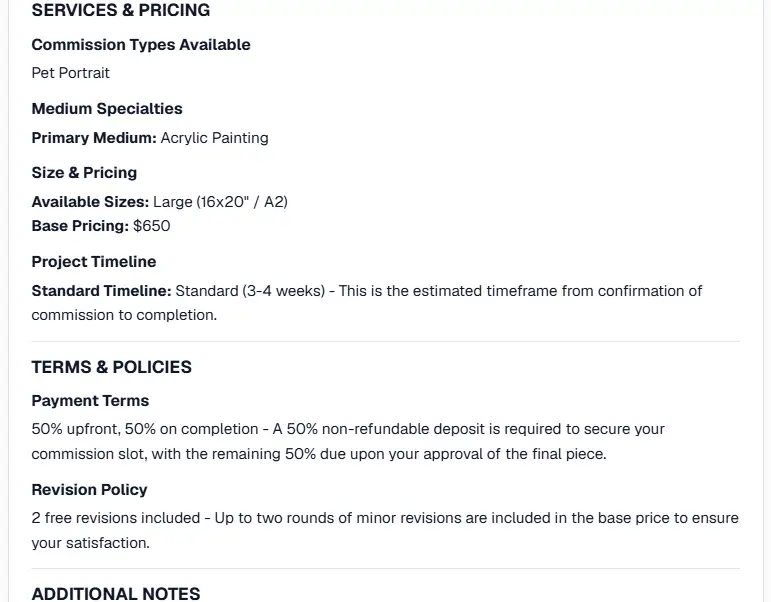
Alongside it came a full rate sheet: your contact details, the payment methods you accept, what you offer at what price, your timeline, and your deposit and revision terms written out as policies. You can edit it, copy it, or download it as a PDF to send with your reply.
Treat the wording as a first draft. It's warm and complete, and a little more effusive than most artists would write, so a quick edit to make it sound like you is worth the minute. The tool is available on Brushly's Professional plan and during the free trial. For working out the number in the first place, the Smart Pricing Calculator has a commission option on every plan.
When the commission is done
Send the deposit invoice when the client says yes, and the balance invoice when they approve the finished piece. Brushly's invoices handle the partial payment in between, so you can see at a glance what's still owed. When it ships, a certificate of authenticity turns a custom piece into a documented original. And a finished commission with the client's permission makes excellent work for your online portfolio, because commissions attract more commissions.
Quick answers
How much should I charge for an art commission?
Start with materials plus your hours, including client time, at a fair hourly rate. Add a margin of around 20 to 50%, then round to a clean number. Keep a price sheet by size so every quote is consistent.
How much deposit should I ask for?
A 50% deposit is the most common arrangement, with the balance due on approval of the finished piece. Smaller commissions are often paid 100% up front.
Should I charge for revisions?
Include a small number, usually two rounds of minor changes, in the price. Quote anything beyond that, or any major change, as extra work, and say so in your terms before you start.
What is a commission price sheet?
A one-page summary of what you offer, your prices by size, and your terms: deposit, revisions, timeline, rush fees and payment methods. It answers most client questions before they're asked.
Answer your next commission inquiry with a price sheet instead of a guess. Every new Brushly account comes with a 7-day free trial, so open Brushly, draft your rate sheet, and send your next quote with confidence. See the plans for which tools each includes.

