A visitor at your stand has been looking at the same painting for ten minutes. Eventually they ask the question you hear every fair: "I love it, but it's a bit beyond me. Do you do prints?" You don't, and they walk away with your card and nothing else.
Selling prints turns one painting into many sales at prices more people can say yes to. The steps are straightforward. Decide whether you'll sell open or limited editions, get a print-ready file of the work, choose the paper or surface, set a price with a real margin, and either keep prints in stock or use print on demand, which prints and ships each order only after it sells. Below: each of those decisions, how to price, the pros and cons of holding stock, and how to have a print made and shipped straight to a collector without it ever passing through your studio.
Open editions, limited editions, or both
| Edition type | What it means | Good for |
|---|---|---|
| Open edition | No limit on how many you sell | Affordable prints, popular images, gifts |
| Limited edition | A fixed number, numbered and usually signed | Collectors who want scarcity and a higher price |
| Artist proofs | A small extra run outside the edition, often priced higher | Rewarding early or loyal collectors |
Many artists do both: an open edition in smaller sizes on paper, and a limited edition of a few dozen at a larger size or on a premium surface. If you promise a limited edition, keep a record of every number you sell and never reprint beyond it. That promise is what collectors are paying for.
Start with a print-ready file
A print can only be as good as the file it's made from. Photograph flat work square-on in even, diffused light, or have it professionally scanned, which is worth it for work with fine detail or subtle colour. Colour-check the file against the original on a calibrated screen before you order anything.
Size matters more than most artists expect. The image you post online is usually far too small to print from. A common rule of thumb is about 300 pixels per inch at the final print size, so an 11 × 14 inch print wants roughly 3,300 × 4,200 pixels. Keep the full-size master file safe, and export smaller copies for the web from it, never the other way round.
Choose the paper or surface
The surface changes how the work feels in someone's hands, and what you can charge for it.
| Surface | What it's like | Suits |
|---|---|---|
| Cotton rag watercolour paper | Matte, textured, soft, archival | Watercolours, drawings, illustration |
| Etching paper | Heavier, velvety, slightly more texture | Limited editions, paintings, lithographs |
| Stretched canvas | Canvas texture, no frame needed | Oil and acrylic work, larger pieces |
| Framed canvas | Canvas in a floating frame, ready to hang | Buyers who want it finished |
| Acrylic panel | High gloss, vivid colour, no frame | Bold, contemporary and photographic work |
| Metal (aluminium) | Smooth, luminous, very durable | Photography, graphic and digital work |
Paper prints are usually the most affordable to produce and ship, which makes them the natural starting point. Canvas and panels cost more but sell at higher prices, and many buyers like that they're ready to hang.
Price prints with a real margin
Work out what one print costs you to deliver: the print itself, shipping, packaging and any selling fees. Then set a price that leaves a margin you're happy with after all of it. As a purely illustrative example, if a print and its shipping cost you $40 and you sell it for $120, you keep $80 before any card or platform fees.
A few habits keep print pricing healthy:
Keep prints clearly below your originals. A print shouldn't compete with the painting it came from.
Price by size and surface, the same way every time, so a buyer comparing two prints sees a consistent logic.
Charge more for limited editions, and consider raising the price as the edition sells out.
Decide how you'll handle shipping, either built into the price or shown separately, and say so clearly.
Keep stock, or print on demand?
| Approach | Why artists choose it | What to watch |
|---|---|---|
| Order a batch and keep stock | Lower cost per print, signing and packing yourself | Upfront cost, storage, unsold prints, your time packing |
| Print on demand | No stock, no upfront spend, every size available | Higher cost per print, less hands-on control |
Print on demand suits artists who are testing which images and sizes sell, who travel, or who simply don't want boxes of prints in the spare room. Holding stock can make sense for your best-selling image in one size, especially if you sell a lot at fairs.
Printing and shipping to collectors with Brushly
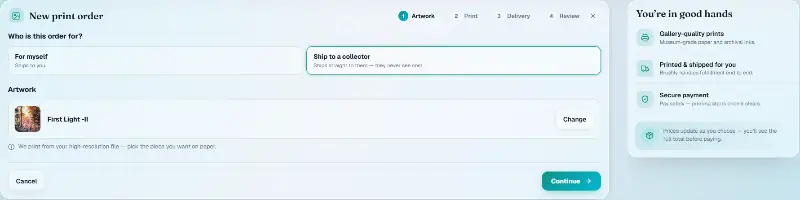
Brushly's print on demand works from the artwork already in your library, and it can send the finished print straight to the person who bought it. A new print order starts with one question: is it for you, or should it ship directly to a collector? When it ships to a collector, they receive the print but never see what it cost you, so the price you charged stays between you.
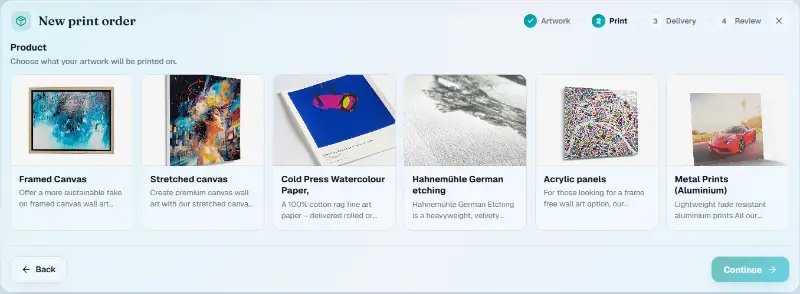
Next you choose what it's printed on. When we tried it, six options were available: framed canvas, stretched canvas, a 100% cotton rag cold press watercolour paper, Hahnemühle German etching paper, acrylic panels and aluminium metal prints. Each has a short description of the material, the finish and how it's delivered.
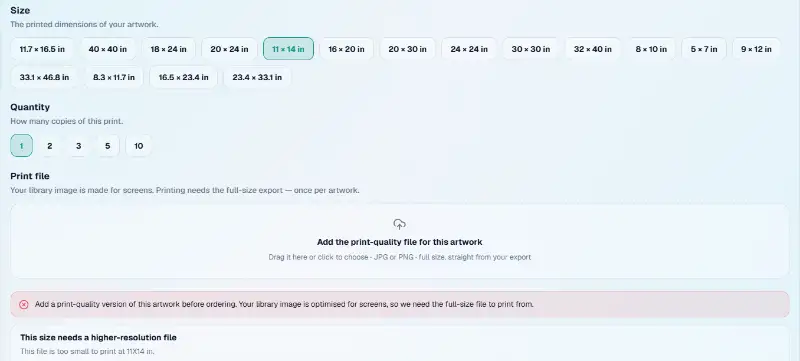
Then you pick a size and a quantity. For the watercolour paper, sizes ran from 5 × 7 inches up to 40 × 40 inches, including standard frame sizes like 8 × 10, 11 × 14 and 16 × 20. You add the full-size file for the artwork once, as a JPG or PNG straight from your export, and every later order of that piece reuses it. Before you can continue, Brushly checks the file against the size you've chosen. In our test we hadn't added the full-size file yet, so at 11 × 14 inches it stopped us with "This size needs a higher-resolution file" and suggested adding the file or choosing a smaller size. That check is what stops a blurry print reaching a collector. Some prints can also include an insert, such as a postcard, flyer or packing slip, which works well as a thank-you note.
After that come delivery and a review of the order. Prices update as you choose, you see the full total before you pay, and printing starts once payment clears. Brushly handles the printing and shipping from there.
Try the papers before you choose
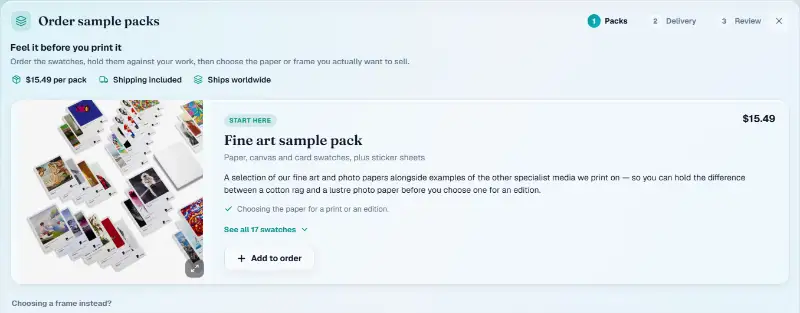
It's hard to pick a paper or a frame colour from a screen. Brushly's sample packs put the real materials in your hands: a fine art sample pack of papers, canvas and card swatches, a frames pack of classic and box frame moulding samples, and a float frames pack for canvas. Each costs $15.49 with shipping included, they ship worldwide, and you can order all three together in one order.
Where to sell your prints
Prints sell best where your originals are already seen.
Your own website. An online portfolio with prices and a buy button lets collectors order directly. Selling from your own site means no marketplace commission, which we cover in selling artwork online with zero commission.
Fairs and open studios. A browser rack of prints at a lower price point turns "just looking" into a sale.
Your email list. Offer subscribers first choice of a new edition. Brushly's email marketing makes that announcement quick to design.
Social media. Show the print in a real room. Mockups put it on a wall at its actual size.
For limited editions, include a certificate of authenticity recording the edition number, so the buyer has a record of exactly which print they own.
Quick answers
Is print on demand worth it for artists?
For most artists starting out with prints, yes. There's no upfront cost and no stock, so you can offer every size and surface and learn what sells before committing money to a batch.
What resolution do I need to sell prints?
A common rule of thumb is about 300 pixels per inch at the final size. An 11 × 14 inch print needs roughly 3,300 × 4,200 pixels, and bigger prints need proportionally more.
Should I sign my prints?
Signing limited editions is standard, usually in pencil below the image along with the edition number. Open edition prints are often left unsigned, or signed at a buyer's request.
How many prints should be in a limited edition?
There's no fixed rule. Smaller editions of 25 to 100 are common, and a smaller edition usually supports a higher price. Whatever you choose, state it and never exceed it.
Say yes the next time someone asks if you do prints. Every new Brushly account comes with a 7-day free trial, so open Brushly, choose a piece from your library, and see it on paper, canvas or metal, shipped straight to whoever buys it. See the plans for what each includes.

