It happens almost by accident. A friend of a friend sees a painting on your Instagram, sends a message, and pays $400 by bank transfer. You wrap it in a towel and a cardboard box and drop it at the post office. Afterwards it hits you: you didn't send an invoice, you're not sure what to charge the next person, and you have no idea which of your other paintings are at home, at the café show, or already sold.
Starting an art business means turning that accident into something repeatable. Decide what you sell and to whom, set prices you can explain, choose where you'll sell, set up how you get paid, keep a record of every piece, and market steadily. None of it has to be complicated. A one-page plan and a handful of habits cover most of it, and the rest you can add as you grow. Here's each step, in the order that tends to work.
Step 1: Write a one-page art business plan
Forget the 40-page document a bank would ask for. What you need is a single page that answers seven questions, so every later decision has something to check against. Here's one filled in for a fictional painter.
| Section | The question | Example answer |
|---|---|---|
| What you make | What exactly do you sell? | Small oil paintings of desert towns at sunrise, plus a few commissions a year |
| Who buys it | Who is the buyer, and why? | Collectors furnishing homes, and visitors who fall for the place |
| Price range | What does a typical piece cost? | $250 to $650 for originals, depending on size |
| Where you sell | Which channels, in which order? | Own website first, then local fairs, then a gallery |
| How buyers find you | What will you do every week? | Three Instagram posts, a monthly email, two fairs a year |
| Money | What does it cost to run, and what's the target? | Materials, framing and fees; a monthly sales target you'd be happy with |
| Next 90 days | What will be different by then? | Website live with prices, 20 email subscribers, 3 pieces sold |
Keep it somewhere you'll see it. Update it every three months, when you know more about what's actually selling.
Step 2: Set prices you can explain
Buyers don't mind prices. They mind prices that seem random. Choose one method and use it everywhere.
The most common starting point is materials plus your time at a fair hourly rate, plus a margin for everything that isn't painting: photography, packing, fees and the pieces that don't sell. Many artists then simplify that into a rate per size, so every 12 × 16 costs the same whatever the subject. Whichever you choose, keep your prices the same on your website, at fairs and in DMs, and raise them gradually as work sells.
If you'd like a starting number rather than a formula, the Smart Pricing Calculator in Brushly's Palette tools suggests a price from your medium, size, time and experience, and it's included on every plan.
Step 3: Choose where to sell
Most artists sell through a mix of channels. Start with one or two and add more once they're working.
| Channel | Why it works | What to watch |
|---|---|---|
| Your own website | No commission, and every buyer becomes your contact | You have to bring the visitors yourself |
| Online marketplaces | Buyers who are already searching | Fees, and competing on price with thousands of listings |
| Galleries | Reach, reputation, established collectors | Commission, consignment terms, fitting their programme |
| Fairs, markets and open studios | Meeting buyers face to face | Stand fees, travel, a lot of lifting |
| Commissions | Steady, pre-sold work | Client time, revisions, clear terms |
| Prints | One image, many sales | Print quality, set-up cost, not undercutting originals |
A website of your own is the one channel worth having from day one, because every other channel sends people back to it. An online portfolio with prices and a way to buy means a collector who finds you anywhere can act on it straight away.
Step 4: Get paid properly
Send an invoice for every sale, even to friends. It's your record, it looks professional, and it makes the next sale to the same person easier. For commissions and larger pieces, ask for a deposit up front, usually half, with the balance due before delivery.
Decide how you'll take payment (card, bank transfer, or both) and write your terms on the invoice: the amount, the due date, and what happens with shipping. Brushly's invoices handle deposits and partial payments, so you can see at a glance what's been paid and what's still owed.
Step 5: Keep track of every piece
The moment your work lives in more than one place, you need a record. For every piece, note the title, year, medium, size, price, status (available, reserved, sold, on display) and where it physically is. A spreadsheet works until you have a few dozen pieces across a studio, a gallery and a fair.
Brushly's inventory keeps that record with locations for each gallery or venue, so you can filter to "everything at the gallery" and export the list. When an original sells, a certificate of authenticity with its own serial and QR code gives the buyer a record of what they bought, and gives you a trail if it's ever resold.
Step 6: Market steadily, not heroically
Marketing is where most new art businesses stall, usually because it's done in bursts. A steady, small rhythm beats an exhausting launch followed by silence.
Social media: a few posts a week on one or two platforms where your buyers actually are. Show the finished work, the process, the story and the piece in a real room.
Email: a monthly note to people who've asked to hear from you, starting with past buyers. Brushly's email marketing designs these around your own brand; sending them is a separate paid add-on.
Your portfolio: the place all of it points to, with prices and a way to buy.
In person: fairs, open studios and openings, where most artists meet their first real collectors.
Step 7: Turn it into a 30-day plan
Knowing what to do is different from knowing what to do on Tuesday. Brushly's Marketing Plan tool turns your situation into a month of specific tasks. It asks three short sets of questions: what you make, your price range and whether you've sold before; your main goal, your biggest challenge and how many hours a week you can give it; and where you're already active online and who you think would love your work.
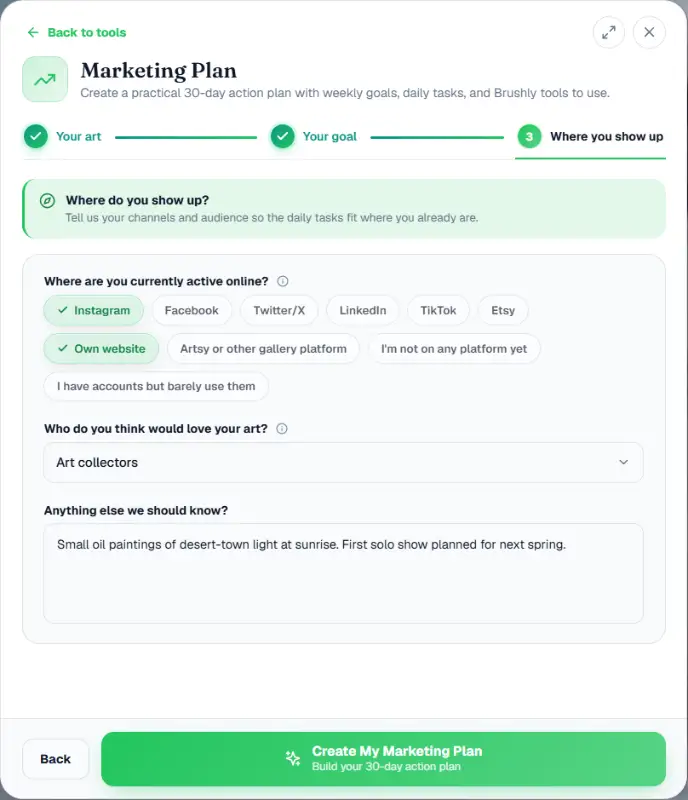
What comes back is a 30-day plan: an overview of what the month should achieve, then four weeks, each with a goal, an estimate of the time it takes, and a task for every day of the week. After the weeks come the metrics to track and what to do after day 30. For our fictional desert painter, week one was "Foundation & Setup", about three to four hours, with tasks from rewriting the About page to engaging with five to ten collector accounts on Instagram. Sunday was left free.
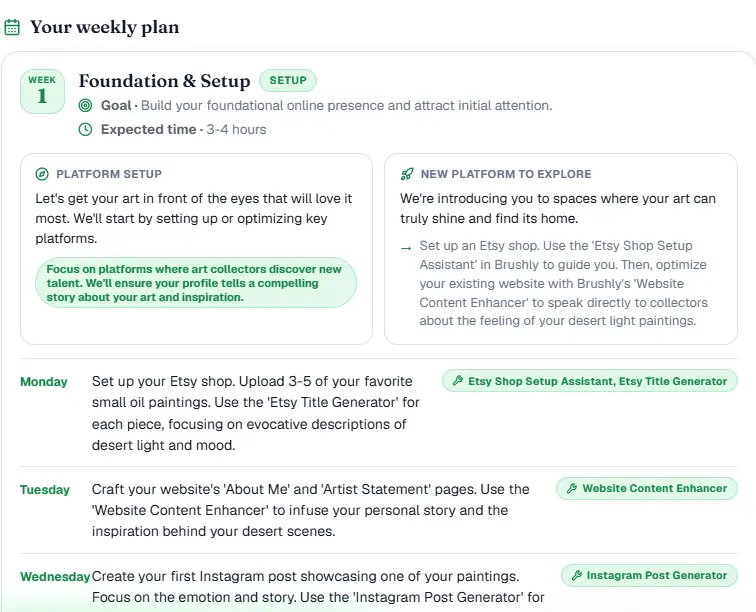
Use it as a structure, and check it against your one-page plan. Ours suggested opening an Etsy shop, although we'd said we sell from our own website, and the summary at the top listed Etsy as a main channel. Some of the tools it recommended, such as an "Email List Builder", aren't Brushly features under those names. Keep the rhythm and the daily tasks that fit, and swap out the rest. You can download the plan as a PDF. The tool is included on Brushly's Professional plan and in the free trial.
The admin nobody tells you about
A few things are worth sorting early, before they become urgent. Rules differ a lot between countries and states, so treat this as a checklist of questions to ask locally, not legal or tax advice.
Registration: find out whether you need to register as a business or get a licence where you live.
A separate bank account: it makes your records far easier to keep, even if it's just a second personal account.
Receipts: keep every receipt for materials, framing, fees and travel. They're costs of the business.
Sales tax or VAT: find out whether you need to collect it on sales, including sales to other states or countries.
An accountant, once: an hour with someone local, early on, usually saves more than it costs.
Quick answers
Do I need a business licence to sell art?
It depends on where you live and how much you sell. Many places require some form of registration once you sell regularly. Check with your local authority or an accountant.
What should I sell first?
Your strongest, most consistent work at prices you can repeat. A small, coherent body of work sells better than a bit of everything.
How much does it cost to start an art business?
Less than people expect. Most artists start with the work they already have, a website, a way to take payment and a system for invoices and records. Add fairs, framing and prints as sales justify them.
How long does it take to make a living from art?
For most artists it takes years rather than months, built on repeat collectors, steady marketing and prices that rise over time. The artists who get there usually treated the business side seriously from the first sale.
Turn your first few sales into a business you can run. Every new Brushly account comes with a 7-day free trial, so open Brushly, put your prices, inventory, invoices and marketing in one place, and build your first 30-day plan. See the plans for what each includes.

