
Your first painting sells on a marketplace. It's listed at $500, and a few weeks later $300 lands in your account. Nothing went wrong. That's the deal you signed up for, you just hadn't done the maths.
Where you sell art online decides how much of each sale you keep. Marketplaces bring you buyers and take anywhere from a few percent to 40% of the price. Your own website keeps almost all of it, but finding the buyers is then your job. Here's what a $500 painting actually nets on the most common options, and how to decide which ones deserve your work.
What a $500 painting actually nets
These figures come from each platform's own fee or pricing page, read in September 2026. Card processing fees apply everywhere, including your own website, and vary by country, so they're left out to keep the comparison fair.
| Where you sell | What the platform takes | You receive |
|---|---|---|
| Saatchi Art | 40% (artists receive 60%) | $300.00 |
| Etsy | $0.20 listing fee plus 6.5% of the price | $467.30 |
| Squarespace, Personal plan | 2% transaction fee | $490.00 |
| Squarespace higher plans, Format, Pixpa | 0% platform fee | $500.00 |
| Your own Brushly portfolio | 0%, no Brushly commission | $500.00 |
The Etsy figure assumes shipping is built into the price. If you charge shipping separately, Etsy's 6.5% applies to the shipping amount too.
The gap widens as your prices rise. On a $2,000 original, a 40% commission is $800. That's not a fee you notice once; it's a painting's worth of income every few sales.
What the fee table leaves out
Three costs sit outside that table, and each one shifts the comparison a little.
Card processing applies on every platform, marketplace or not. It's usually a few percent plus a small fixed fee per payment, and it varies by country, so budget for it everywhere rather than using it to pick a winner.
A website of your own has a monthly plan, a marketplace usually doesn't. Spread across a year of sales, a plan price is often smaller than a single commission on a mid-priced original, but it's a cost even in the months nothing sells.
Shipping is the one people forget. Saatchi Art handles it for you, and you pay only for packaging. On your own site you pack, ship and insure the work yourself, and you set the shipping price the buyer pays. For large or fragile originals, that's real work, and it belongs in your price.
Marketplaces: you're paying for the audience
The case for a marketplace isn't the fees. It's the people already browsing.
Saatchi Art is the clearest example. You receive 60% of every sale, and in return Saatchi handles shipping, so you only pay for packaging. It charges no listing fees, lets you sell the same work elsewhere, and according to its own seller page has sold work to collectors in more than 140 countries. For an artist with no audience yet, that reach is real.
Etsy takes far less: a $0.20 listing fee for each item and 6.5% of the sale. Its buyers skew towards prints, small originals and gifts rather than serious collectors. Listings also expire every four months and renew, at another $0.20 each time, unless you turn auto-renew off. Optional advertising costs extra.
Artsy is often listed alongside these, but its own partner page describes it as a way for galleries to reach collectors. Most individual artists reach it through a gallery that represents them, not by signing up themselves.
The trade is straightforward. The more a marketplace does for you, finding buyers, shipping and handling payments, the more of each sale it keeps.
Your own website: you keep the money, you bring the buyers
A website of your own flips that trade. Most builders now charge no platform fee on sales above their entry plans, so a $500 painting stays close to $500. The costs move elsewhere: a monthly plan, and the work of sending people to it.
That second cost is smaller than it sounds if you already have followers. An Instagram audience, a newsletter, past collectors and people you meet at fairs can all be sent to one link instead of into a marketplace that takes a cut. There's more on why selling through your own portfolio matters if you're weighing that step.
The case for doing both
You don't have to choose once and forever. Plenty of artists use a marketplace for discovery and their own portfolio for everything else.
A reasonable split: list a selection on a marketplace to be found by strangers, and put your full body of work, and anything above a few hundred dollars, on your own site. When someone who found you on a marketplace comes back for a second piece, send them to your portfolio. They already trust you, and there's no reason to pay 40% for a buyer you've already met.
The one rule is to keep your prices consistent everywhere. A collector who finds the same painting cheaper on your site than on a marketplace, or the other way round, starts to distrust both.
Selling from your own portfolio with Brushly
Brushly's online portfolio is built for exactly that second channel. It shows your work, your story and your contact details, and lets a collector buy an original directly, without you in the middle.
On the artwork's page, the buyer sees the price, whether it's the last one available, and the editions to choose from, such as the original or a print. One button starts a secure Stripe checkout, and the panel says where you ship.
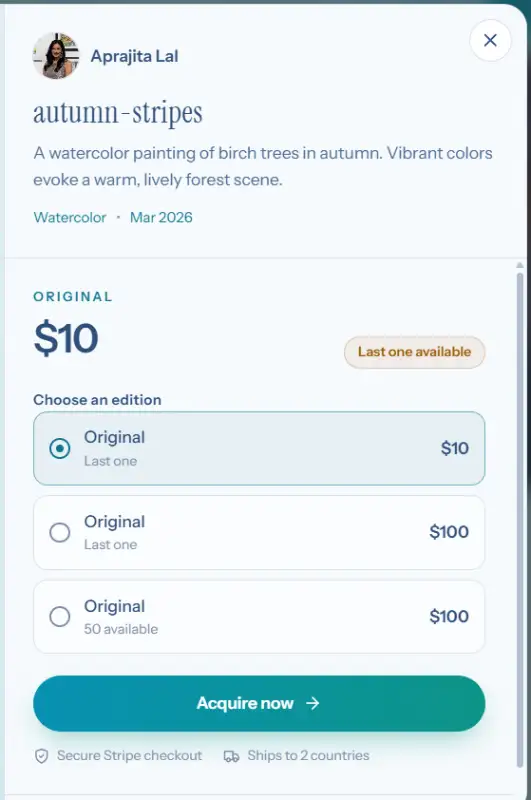
The payment goes straight to your own Stripe account, and Brushly takes no commission on the sale. Artists in India can also accept UPI, where the buyer pays you directly and you confirm it before shipping. While a buyer is at checkout, the piece is held, so two people can't both buy the last original. And when the payment goes through, the artwork is marked sold in your inventory, the buyer is added to your collectors, and the sale is recorded as a paid invoice. No spreadsheet to update afterwards.
A piece only goes on sale once it's ready: priced, in stock, and set to ship to the buyer's country. So nothing is listed by accident, and you can issue its certificate of authenticity from the same record once it sells.
How to choose where to sell your art online
If you have no audience yet, start with a marketplace for reach, and build your own portfolio alongside it so you have somewhere to send people when they find you.
If you already have followers on Instagram or a mailing list, lead with your own portfolio. You're already doing the marketing that marketplaces charge for.
If you sell originals above a few hundred dollars, keep them on a channel that takes no commission. At higher prices, the percentage a marketplace keeps is often more than your materials cost.
And if you sell prints and small works in volume, a marketplace like Etsy can make sense, as long as the listing and transaction fees are built into your prices.
Quick answers
How much does Saatchi Art take from artists?
According to Saatchi Art's seller page, artists receive 60% of every artwork sold, so Saatchi keeps 40%. It handles shipping, and you pay only for packaging.
How much does Etsy charge to sell art?
A $0.20 listing fee per item, which renews every four months, plus a 6.5% transaction fee on the displayed price and any shipping you charge. Payment processing and optional ads are extra.
Is it better to sell on a marketplace or my own website?
A marketplace is better for being discovered, and your own website is better for keeping the money. Most artists who sell consistently use both: a marketplace to be found, and their own site for repeat buyers and higher-priced work.
Do I need a website to sell art online?
Not to start, but it becomes the most profitable channel once people are looking for you. A portfolio link can take payments directly, so you're not paying commission on buyers you found yourself.
Set up the channel you keep all of. Every new Brushly account comes with a 7-day free trial, so open Brushly, set up your portfolio, and put your first piece up for sale. See the plans for what each includes.

