The listing form has one empty box left: "Title". The file on your desktop is called IMG_1030. You look at the painting, a forest with light pooling on the floor, and type "Forest Light" for the third time this year.
A good title helps people remember a piece, find it again, and talk about it. It can describe what's there, name the place or moment, capture a mood, borrow a turn of phrase, or stay deliberately plain. The trick is choosing an approach that suits the work and using it consistently across a series. Below: seven ways to title a painting with original examples for each, what makes a title help a sale, the mistakes to avoid, and a quick way to get a shortlist when you're stuck.
Seven ways to title a painting
| Approach | Good for | Examples |
|---|---|---|
| Descriptive | Still lifes, portraits, clear subjects | Three Pears on a Blue Cloth · Harbour at Low Tide · The Red Chair |
| Place and time | Landscapes, plein air, cityscapes | Taos, 6:14 a.m. · Late October, Hebden Bridge · First Snow on Elm Street |
| Mood | Abstracts, atmospheric work | The Quiet Before · Held Breath · Almost Warm |
| Overheard phrase | Figurative and narrative work | We Should Have Brought Coats · Not Yet, Not Yet · She Said Tuesday |
| Metaphor | Work that suggests more than it shows | The Forest Exhales · A Map of Leaving · Salt Memory |
| Series and number | Large bodies of work, studies | Tidewater No. 7 · Study in Ochre, 12 · Grid Variation IV |
| Untitled, with a hint | Work you'd rather not steer | Untitled (Blue Study) · Untitled, 2026 · Untitled (for M.) |
Descriptive titles are the easiest for buyers to remember and search for. They're never wrong, just sometimes plain.
Place and time titles give a painting a story in a few words. A time of day or a date makes a plein air piece feel like a record of a real moment, because it is one.
Mood titles suit abstract work, where describing the contents would say nothing. Keep them short, and avoid the words everyone uses ("Serenity", "Harmony", "Dreams").
Overheard phrases are fragments of speech you jot down in a notebook. They make figurative work feel like a scene from a story, and they're yours. Avoid lifting lines from poems or songs: it's not original, and it may not be yours to use.
Metaphor titles work when they add something the painting doesn't say on its own. If the title only repeats the image in fancier words, cut it back to a descriptive one.
Series and numbers keep large bodies of work organised, and they make it clear to collectors that a piece belongs to something larger. Give the series itself a strong name.
Untitled is a legitimate choice when you don't want to steer the viewer. A small hint in brackets helps people tell one untitled piece from another.
What makes a title help a sale
You can say it out loud. Collectors talk about work to friends and partners before they buy. If a title is hard to pronounce or remember, it doesn't travel.
It includes one searchable word. "Where Golden Light Pools" is lovely. "Where Golden Light Pools on the Forest Floor" is findable. One concrete noun, such as forest, harbour or sunflower, helps people search for the piece later.
It's distinctive enough to find. If a buyer types the title and your name into a search engine, they should find your piece, not thousands of others with the same name.
It fits the series and the price. A $3,000 canvas deserves a considered title. A set of small studies can carry numbered titles without seeming careless.
Title mistakes to avoid
Too long. More than six or seven words starts to read like a caption.
Explaining the painting. "A Woman Waiting for News That Never Comes" leaves the viewer nothing to discover.
The same word everywhere. Five paintings called some version of "Light" blur together in a collector's memory and your inventory.
Clichés. "Serenity", "Untitled #45" for everything, "Autumn Dreams".
Changing it after it sells. The title is on the invoice, the certificate and the collector's records. Choose before the piece goes out.
Your title and your listing title are different things
On a marketplace or your own shop, the listing title does a different job from the artwork title. The artwork title stays clean: "Where Golden Light Pools". The listing title adds what a buyer might search for: "Where Golden Light Pools, original watercolour forest painting, 12 × 16 in". Keep the artwork's own title the same everywhere, and let the listing carry the extra words. Brushly's Palette tools include separate tools for Etsy titles and SEO titles for exactly this reason.
Naming a whole series at once
Titling ten paintings one at a time is where most of the "Forest Light #3" titles come from. It's easier to decide the pattern first and let each title follow it.
Start by naming the series itself, with the strongest title you can find, because it will appear on your website, in exhibition lists and in every caption. Then choose one rule for the individual pieces: all places, all times of day, all overheard phrases, or all numbers. A series of harbour paintings might run "Tidewater, 5:40 a.m.", "Tidewater, Noon", "Tidewater, Last Light". Collectors immediately see that the pieces belong together, and each still has a name of its own.
Keep a running list of titles you like but haven't used yet, in the same notebook as the overheard phrases. When a new piece is finished, you're choosing from a list rather than starting from nothing.
Getting title ideas with Brushly
When you're stuck, a shortlist to react to is faster than a blank box. Brushly's Artwork Title tool, one of the Palette tools, starts from the painting itself. Choose an artwork from your library, and it looks at the image and suggests titles, each labelled with its style and a short note on why it works.
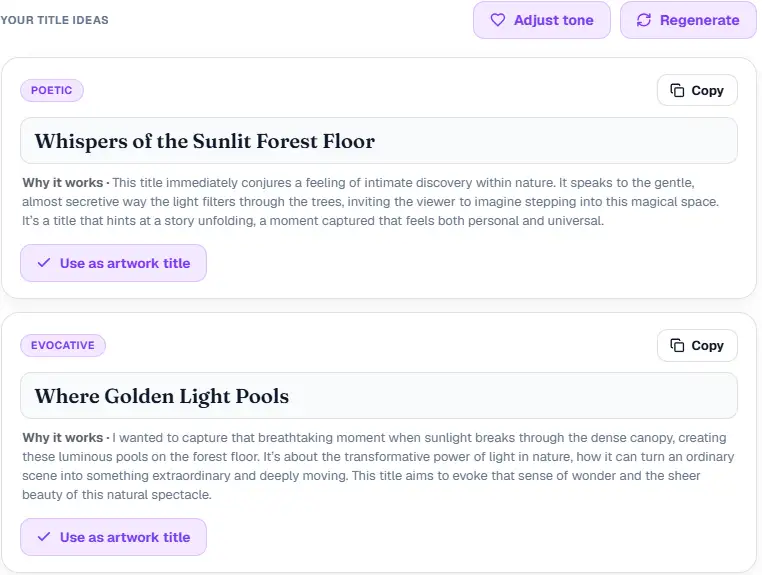
For our untitled forest painting, IMG_1030, it came back with "Whispers of the Sunlit Forest Floor" (poetic), "Where Golden Light Pools" (evocative) and "The Forest Breathes Light" (metaphorical). The tool describes five directions, but our run returned three, which was still enough to choose from. The notes were helpful on why each title works, though they slipped into the first person in places, as if the artist had written them.
You can edit any title in place, copy it, or regenerate with a quick steer: more poetic, shorter, more mysterious, more descriptive or more contemporary. When you've chosen, "Use as artwork title" renames the piece in your library, so the new title follows it onto your online portfolio. The tool is included on Brushly's Professional plan and in the free trial.
Keep your titles consistent everywhere
Once a piece has a title, use it identically everywhere it appears. Record it in your inventory with the year, medium and size, so the same details go onto your invoices and price lists. When it sells, the certificate of authenticity carries the same title, which matters if the piece is ever resold. And when you post it, use the title in the caption too. Our guide to Instagram captions for artists shows how to work it in naturally.
Quick answers
Do I have to title my artwork?
No, but untitled work is harder to talk about, search for and keep track of. Even a descriptive or numbered title makes life easier for you and your buyers.
Is "Untitled" a good title?
It's fine when you truly don't want to guide the viewer. Add a hint in brackets, such as a colour or a year, so pieces can be told apart.
How long should an artwork title be?
One to six words suits most work. Short titles are easier to remember and to say when recommending a piece to someone else.
Can I change a title after a painting sells?
It's best not to. The title appears on the invoice, the certificate and the buyer's records, so changing it later causes confusion.
Name your next piece before the listing form asks. Every new Brushly account comes with a 7-day free trial, so open Brushly, choose an untitled artwork, and get a shortlist of titles to edit and make your own. See the plans for which tools each includes.

